


Page 381 - (ISC)² CISSP Certified Information Systems Security Professional Official Study Guide
P. 381
ciphers straight is to remember that codes work on words and
                  phrases, whereas ciphers work on individual characters and bits.


               Transposition Ciphers

               Transposition ciphers use an encryption algorithm to rearrange the
               letters of a plaintext message, forming the ciphertext message. The

               decryption algorithm simply reverses the encryption transformation to
               retrieve the original message.

               In the challenge-response protocol example in Figure 6.1 earlier in this
               chapter, a simple transposition cipher was used to reverse the letters
               of the message so that apple became elppa. Transposition ciphers can
               be much more complicated than this. For example, you can use a
               keyword to perform a columnar transposition. In the following

               example, we’re attempting to encrypt the message “The fighters will
               strike the enemy bases at noon” using the secret key attacker. Our first
               step is to take the letters of the keyword and number them in
               alphabetical order. The first appearance of the letter A receives the
               value 1; the second appearance is numbered 2. The next letter in

               sequence, C, is numbered 3, and so on. This results in the following
               sequence:

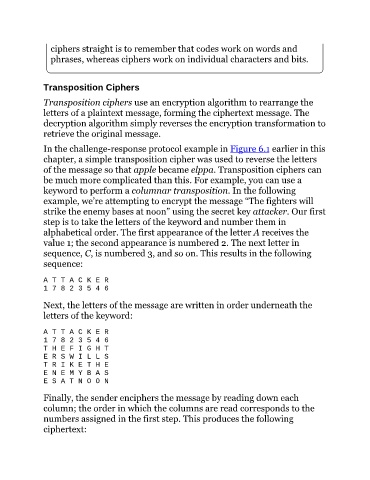
               A T T A C K E R
               1 7 8 2 3 5 4 6

               Next, the letters of the message are written in order underneath the
               letters of the keyword:


               A T T A C K E R
               1 7 8 2 3 5 4 6
               T H E F I G H T
               E R S W I L L S
               T R I K E T H E
               E N E M Y B A S
               E S A T N O O N

               Finally, the sender enciphers the message by reading down each
               column; the order in which the columns are read corresponds to the

               numbers assigned in the first step. This produces the following
               ciphertext:

