


Page 382 - (ISC)² CISSP Certified Information Systems Security Professional Official Study Guide
P. 382
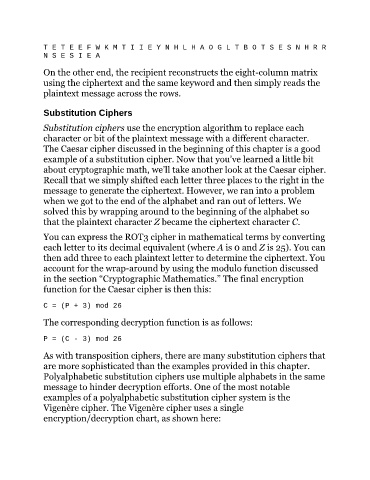
T E T E E F W K M T I I E Y N H L H A O G L T B O T S E S N H R R
               N S E S I E A

               On the other end, the recipient reconstructs the eight-column matrix
               using the ciphertext and the same keyword and then simply reads the
               plaintext message across the rows.


               Substitution Ciphers


               Substitution ciphers use the encryption algorithm to replace each
               character or bit of the plaintext message with a different character.
               The Caesar cipher discussed in the beginning of this chapter is a good
               example of a substitution cipher. Now that you’ve learned a little bit
               about cryptographic math, we’ll take another look at the Caesar cipher.
               Recall that we simply shifted each letter three places to the right in the
               message to generate the ciphertext. However, we ran into a problem

               when we got to the end of the alphabet and ran out of letters. We
               solved this by wrapping around to the beginning of the alphabet so
               that the plaintext character Z became the ciphertext character C.

               You can express the ROT3 cipher in mathematical terms by converting
               each letter to its decimal equivalent (where A is 0 and Z is 25). You can
               then add three to each plaintext letter to determine the ciphertext. You
               account for the wrap-around by using the modulo function discussed

               in the section “Cryptographic Mathematics.” The final encryption
               function for the Caesar cipher is then this:

               C = (P + 3) mod 26


               The corresponding decryption function is as follows:

               P = (C - 3) mod 26

               As with transposition ciphers, there are many substitution ciphers that

               are more sophisticated than the examples provided in this chapter.
               Polyalphabetic substitution ciphers use multiple alphabets in the same
               message to hinder decryption efforts. One of the most notable
               examples of a polyalphabetic substitution cipher system is the
               Vigenère cipher. The Vigenère cipher uses a single

               encryption/decryption chart, as shown here:

