


Page 406 - (ISC)² CISSP Certified Information Systems Security Professional Official Study Guide
P. 406
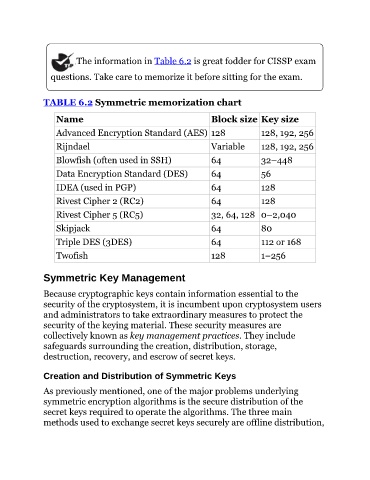
The information in Table 6.2 is great fodder for CISSP exam

                  questions. Take care to memorize it before sitting for the exam.


               TABLE 6.2 Symmetric memorization chart


                    Name                                               Block size Key size

                    Advanced Encryption Standard (AES) 128                             128, 192, 256
                    Rijndael                                           Variable        128, 192, 256

                    Blowfish (often used in SSH)                       64              32–448

                    Data Encryption Standard (DES)                     64              56

                    IDEA (used in PGP)                                 64              128

                    Rivest Cipher 2 (RC2)                              64              128

                    Rivest Cipher 5 (RC5)                              32, 64, 128 0–2,040
                    Skipjack                                           64              80

                    Triple DES (3DES)                                  64              112 or 168

                    Twofish                                            128             1–256


               Symmetric Key Management


               Because cryptographic keys contain information essential to the
               security of the cryptosystem, it is incumbent upon cryptosystem users
               and administrators to take extraordinary measures to protect the
               security of the keying material. These security measures are
               collectively known as key management practices. They include

               safeguards surrounding the creation, distribution, storage,
               destruction, recovery, and escrow of secret keys.


               Creation and Distribution of Symmetric Keys

               As previously mentioned, one of the major problems underlying
               symmetric encryption algorithms is the secure distribution of the
               secret keys required to operate the algorithms. The three main
               methods used to exchange secret keys securely are offline distribution,

