


Page 408 - (ISC)² CISSP Certified Information Systems Security Professional Official Study Guide
P. 408
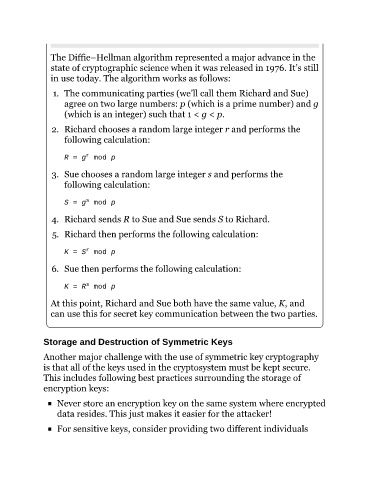
The Diffie–Hellman algorithm represented a major advance in the
                  state of cryptographic science when it was released in 1976. It’s still
                  in use today. The algorithm works as follows:

                   1.  The communicating parties (we’ll call them Richard and Sue)

                      agree on two large numbers: p (which is a prime number) and g
                      (which is an integer) such that 1 < g < p.

                  2.  Richard chooses a random large integer r and performs the
                      following calculation:


                             r
                      R = g  mod p
                  3.  Sue chooses a random large integer s and performs the
                      following calculation:


                             s
                      S = g  mod p
                  4.  Richard sends R to Sue and Sue sends S to Richard.


                  5.  Richard then performs the following calculation:

                             r
                      K = S  mod p

                  6.  Sue then performs the following calculation:

                             s
                      K = R  mod p

                  At this point, Richard and Sue both have the same value, K, and
                  can use this for secret key communication between the two parties.


               Storage and Destruction of Symmetric Keys

               Another major challenge with the use of symmetric key cryptography
               is that all of the keys used in the cryptosystem must be kept secure.
               This includes following best practices surrounding the storage of
               encryption keys:

                    Never store an encryption key on the same system where encrypted
                    data resides. This just makes it easier for the attacker!


                    For sensitive keys, consider providing two different individuals

