


Page 425 - (ISC)² CISSP Certified Information Systems Security Professional Official Study Guide
P. 425
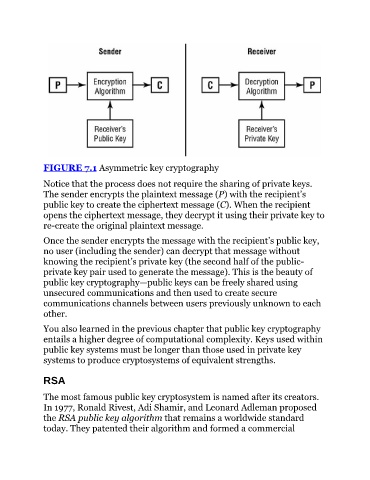
FIGURE 7.1 Asymmetric key cryptography

               Notice that the process does not require the sharing of private keys.
               The sender encrypts the plaintext message (P) with the recipient’s
               public key to create the ciphertext message (C). When the recipient

               opens the ciphertext message, they decrypt it using their private key to
               re-create the original plaintext message.

               Once the sender encrypts the message with the recipient’s public key,
               no user (including the sender) can decrypt that message without
               knowing the recipient’s private key (the second half of the public-
               private key pair used to generate the message). This is the beauty of

               public key cryptography—public keys can be freely shared using
               unsecured communications and then used to create secure
               communications channels between users previously unknown to each
               other.

               You also learned in the previous chapter that public key cryptography
               entails a higher degree of computational complexity. Keys used within
               public key systems must be longer than those used in private key

               systems to produce cryptosystems of equivalent strengths.


               RSA

               The most famous public key cryptosystem is named after its creators.
               In 1977, Ronald Rivest, Adi Shamir, and Leonard Adleman proposed
               the RSA public key algorithm that remains a worldwide standard

               today. They patented their algorithm and formed a commercial

