


Page 428 - (ISC)² CISSP Certified Information Systems Security Professional Official Study Guide
P. 428
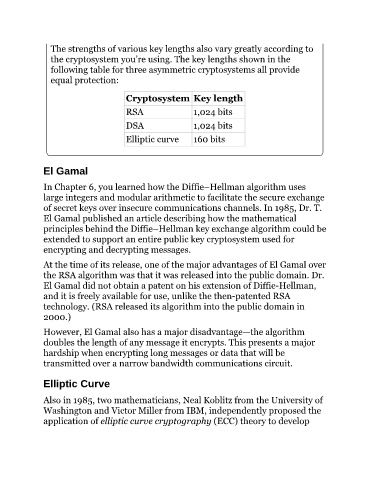
The strengths of various key lengths also vary greatly according to
                  the cryptosystem you’re using. The key lengths shown in the

                  following table for three asymmetric cryptosystems all provide
                  equal protection:


                                           Cryptosystem Key length
                                           RSA                   1,024 bits

                                           DSA                   1,024 bits

                                           Elliptic curve        160 bits


               El Gamal


               In Chapter 6, you learned how the Diffie–Hellman algorithm uses
               large integers and modular arithmetic to facilitate the secure exchange
               of secret keys over insecure communications channels. In 1985, Dr. T.
               El Gamal published an article describing how the mathematical
               principles behind the Diffie–Hellman key exchange algorithm could be
               extended to support an entire public key cryptosystem used for

               encrypting and decrypting messages.

               At the time of its release, one of the major advantages of El Gamal over
               the RSA algorithm was that it was released into the public domain. Dr.
               El Gamal did not obtain a patent on his extension of Diffie-Hellman,
               and it is freely available for use, unlike the then-patented RSA
               technology. (RSA released its algorithm into the public domain in

               2000.)

               However, El Gamal also has a major disadvantage—the algorithm
               doubles the length of any message it encrypts. This presents a major
               hardship when encrypting long messages or data that will be
               transmitted over a narrow bandwidth communications circuit.


               Elliptic Curve


               Also in 1985, two mathematicians, Neal Koblitz from the University of
               Washington and Victor Miller from IBM, independently proposed the
               application of elliptic curve cryptography (ECC) theory to develop

