


Page 849 - (ISC)² CISSP Certified Information Systems Security Professional Official Study Guide
P. 849
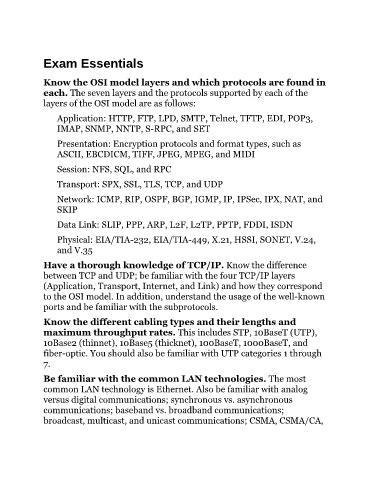
Exam Essentials


               Know the OSI model layers and which protocols are found in
               each. The seven layers and the protocols supported by each of the
               layers of the OSI model are as follows:


                    Application: HTTP, FTP, LPD, SMTP, Telnet, TFTP, EDI, POP3,
                    IMAP, SNMP, NNTP, S-RPC, and SET

                    Presentation: Encryption protocols and format types, such as
                    ASCII, EBCDICM, TIFF, JPEG, MPEG, and MIDI

                    Session: NFS, SQL, and RPC

                    Transport: SPX, SSL, TLS, TCP, and UDP

                    Network: ICMP, RIP, OSPF, BGP, IGMP, IP, IPSec, IPX, NAT, and
                    SKIP


                    Data Link: SLIP, PPP, ARP, L2F, L2TP, PPTP, FDDI, ISDN

                    Physical: EIA/TIA-232, EIA/TIA-449, X.21, HSSI, SONET, V.24,
                    and V.35

               Have a thorough knowledge of TCP/IP. Know the difference
               between TCP and UDP; be familiar with the four TCP/IP layers
               (Application, Transport, Internet, and Link) and how they correspond
               to the OSI model. In addition, understand the usage of the well-known
               ports and be familiar with the subprotocols.


               Know the different cabling types and their lengths and
               maximum throughput rates. This includes STP, 10BaseT (UTP),
               10Base2 (thinnet), 10Base5 (thicknet), 100BaseT, 1000BaseT, and
               fiber-optic. You should also be familiar with UTP categories 1 through
               7.

               Be familiar with the common LAN technologies. The most

               common LAN technology is Ethernet. Also be familiar with analog
               versus digital communications; synchronous vs. asynchronous
               communications; baseband vs. broadband communications;
               broadcast, multicast, and unicast communications; CSMA, CSMA/CA,

