


Page 366 - Arte e Historia
P. 366
Danilo De los Santos

unique case, shares the same territory with another na-         School. Names associated to the 1960’s decade: Cándido
tion, differentiated and sister at the same time.               Bidó, Alberto Bass, León Bosch, Adolfo Piantini, Vicente
                                                                Pimentel, Roberto Flores, Julia de Guerra, Virgilio Méndez,
    On the Dominican socio-geographical body, art history       Orlando Menicucci, Ramón Oviedo, José Ramírez Conde,
is a concrete and spiritual manifestation expanding in vari-    Nancy Rosado, Geo Ripley and Justo Susana. Novísimos
ous cycles from past to present; period this later in which,    from 1970: Alonso Cuevas, Melchor Terrero, Alberto
the artists and their creative work draw up the diachronic      Ulloa, Fernando Ureña Rib and Carlos Hidalgo.
and the synchrony. The later results been multiple whenever
confluent generations and their diverse linguistic, thematic    Yoryi Morel. The master. Was 64 years old by 1974
and visual discourses, meet. The aesthetic breezes transfuse
the modern creations without diminishing this art authen-       when he created the piece «Market.» At that time he
ticity nor its identity. It remains an irrefutable, mysterious  resided at a large wooden house with hipped roofs, the
and transcendental treasure of the Dominican being.             same one where he was born in 1906. There he had his
                                                                atelier redesigned several times. Among them «Good
    There is not a cultural manifestation more liberat-         fortune,» the latrine transformed into a refuge for his
ing than art. By it, every human being inspired by his her      juvenile productions, like «Wagner,» the pale colors il-
power of invention, resembles the Creator Father. By di-        lustrated fanzine. 50 years have passed since the edition,
vine delegation, the artist creates and recreates life, in a    published in 1924, preserved as a memorable work. In
monologue with his-her inner cognitive and imagination’s        the Fall of his life, father of five, three of them born to
powers as well as in a dialogue with his-her fellow artist.     his beloved Ilonka Szaba, the painter use to incessantly
The dialogue between diverse artists allows us to get into      conjugate ranges of colors with his palette and brushes,
the 1970’s decade, a period when many representatives of        interrupted from time to time by different afflictions:
various generations coincide, so we can talk about brand        the cigar puff, the rum sip, his violin, the visitors siege
new, young recognized names and well known veterans.            and the necessity to cover the family expenses with art
All of then keeping distance from the rest as individuali-      pieces for the best buyer of his imaginary, mainly «local-
ties, while at the same time, synchronizing their experience    colour» themes he used to sign on cardboard, canvas and
as part of the same arts local history.                         paper. The billow affecting his pupils finally made him
                                                                half blind, but Yoryi Morel was a conscious artist with an
    Within the treasure that represents the Banco Popu-         unstoppable instinct. Only death would stop him.
lar’s art collection, the inter-generations encounter al-
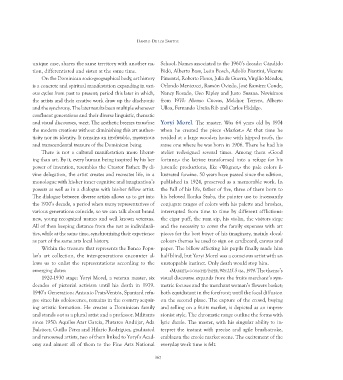
lows us to enlist the representations according to the              «Market,» gouache/paper, 90x115.5 cm., 1974. The theme’s
emerging dates:                                                 visual discourse expands from the fruits merchant’s sym-
                                                                metric focuses and the merchant woman’s flowers basket;
    1920-1930 stage: Yoryi Morel, a veteran master, six         both equidistant in the forefront; until the focal diffusion
decades of pictorial activism until his death in 1979.          on the second plane. The capture of the crowd, buying
1940’s Generation: Antonio Prats-Ventós, Spaniard refu-         and selling on a fruits market, is depicted as an impres-
gee since his adolescence, remains in the country acquir-       sionist style. The chromatic range outline the forms with
ing artistic formation. He creates a Dominican family           lyric dazzle. The master, with his singular ability to in-
and stands out as a plural artist and a professor. Militants    terpret the instant with precise and agile brush-stroke,
since 1950: Aquiles Azar García, Plutarco Andújar, Ada          emblazon the creole market scene. The excitement of the
Balcácer, Guillo Pérez and Hilario Rodríguez, graduated         everyday work time is felt.
and renowned artists, two of them linked to Yoryi’s Acad-
emy and almost all of them to the Fine Arts National

                                                                367

