


Page 362 - Arte e Historia
P. 362
Danilo De los Santos

opposite hillsides. The view includes the Yaque River         is not imitative nor limitative on her original referential
and a background of mountains and a cloudy sky. A red         and pictorial findings. In the critic Manuel Valldeperes
dressed character is visible. «Laundry Women,» oil/canvas,    words: «Ada Balcácer’s painting not only reveals the human
25x18 cm., 1961. A painting with three composition planes     being on its essence. It is the outcome of a new search on this es-
in unity: the first one, defined by three laundry women       sentiality. The subject on her paintings -and this is constant on
and two large earthenware jars. She washes clothe in the      her- is not corrupted or degraded. Hers, are shaken, throbbing,
river that forms the second and main plane extending          canvas (…) those art soft chromatic fluid forms (…) trying to
to a distant view of a river band; defined by foliage, huts   penetrate the being essentiality, after having penetrated the na-
and ranchos on the hillside and the sky. This is the third    ture’s.» (El Caribe, September 28, 1968) In the balcacian
composition’s plane. «Trunks,» oil/canvas, 24x32 cm., 1962.   piece «The Television,» penetrated nature combines on a
Landscape defined by high and huge trunks of a pine           framed face the ritual of a spiritual subject, which displays
tree wood. In the middle, a farmer transport a beast of       its essence in a duplicated retro vision of a single eye.
burden. As a supplementary scene, plains, a hamlet, foli-
age and a mountain chain adjoining a lighted up sky.          Paul Giudicelli. (San Pedro de Macorís, 1921/Santo
«Vignette,» gouache/paper, 13x18 cm., 1966. The Yoryian
production was always accessible to the audience wishing      Domingo, 1965). His parents, from Corsica, became
one of his pieces, without social class distinction or price  French settlers at the Porvenir Sugar Factory. Paul was
bargaining. The master created many Vignettes like this       one of seven siblings, some of them raised up at Boca
one of a peasant woman with a lighted silhouette, whose       Chica’s Sugar Factory vicinity. In 1928, the family trav-
brownish skin tone shines with the contrasting colors of      els to France and remains there until the return back to
her clothes and the atmosphere’s. There, the artist adds      Dominican Republic, at the beginning of the 1930s. A
his signature and the piece date in orange-colored italics.   vehement drawer since his childhood, he completes his
                                                              basic school in the country, finishing later on his high-
Ada Balcácer. (Santo Domingo, 1930). She studied at the       school and commercial studies. Married very young and
                                                              father of two, he works unsuccessfully as a salesman in
Fine Arts National School (1946-1951) and took supple-        various locations. He decided to study Philosophy at the
mentary courses at the Puerto Rico’s University free work-    University of Santo Domingo (1948), where he is encour-
shop (1952-1955). Ada immigrated to New York where            aged to join the Fine Arts National School. Graduated
she worked as the Ebony Magazine and industrial fabric        in 1951, takes part at Sao Paulo Biennial in 1952, and
designer. There, her conscience as a militant and commit-     held his first individual showing in 1953, composed of a
ted woman, grew up. At the beginning of the 1960’s she        group of 70 pieces (oil, gouache, watercolor, drawings…)
returns back to the country, strengthening her creations      at the National Gallery.
with popular references, projecting herself from that mo-
ment as a multifaceted woman artist (drawer, engraver,            The critic Horia Tanasescu wrote about the showing:
painter, revolutionary) reaching the status of a master. In   «Apart from showing an uncommon talent, the first individual
1966 she won the León Jimenes Drawing Competition’s           exhibition of Paul Giudicelli points at the appearance of a new
First Prize and co-founded Grupo Proyecta (1968-1970)         energy on the national visual arts field, a substantial energy full
                                                              of fertile seeds that places this painter in his full right among those
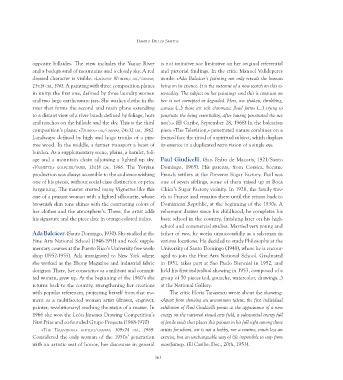
     «The Television,» acrylic/canvas, 109x74 cm., 1969.      artists for whom, art is not a hobby, nor a routine, much less an
Considered the only woman of the 1950s’ generation            exercise, but an unchangeable way of life impossible to stop from
with an artistic seat of honor, her discourse in general      manifesting». (El Caribe, Dec., 20th, 1953).

363

