


Page 116 - sarah-simblet_sketch-book-for-the-artist
P. 116
THE BODY116

          Measurement and Foreshortening

          FORESHORTENING IS AN ASPECT of perspective. In the life class   But if we could take a scaffold and climb up to the work,
          it is the mechanism for ensuring that a drawn figure lies       we would arrive to find many of the same figures strangely
          correctly in pictorial space - limbs happily receding, or       distorted, elongated as if stretched across the plaster. Up close
          coming forward, without taking off, plummeting, or shrivelling  on the scaffold we would witness Michelangelo's subtle
          at odd, unfathomable angles. It is not so hard; patience,       application of accelerated perspective, which is imperceptible
          persistence, and a few measured comparisons are key. How        from below. Smaller, more extreme examples have been made
          to make and apply these is explained below and opposite.        for court entertainment, to be translated by mirrors or seen
                                                                          from only one point in the room; for example, the skull in
             We also look at another very interesting branch called       Holbein's The Ambassadors (The National Gallery, London).
          accelerated (or anamorphic) perspective. This is chiefly a
          correcting device by which figurative painters and sculptors        Accelerated perspective plays a great role in much art. It
          have for centuries countered the effects of our viewing their   can also be a little demon in the life room, when beginners
          work from far below or on the curvature of a vault. Imagine     prop their board in their lap and look down at too steep an
          Michelangelo's murals in the Sistine Chapel, Rome, with         angle. To avoid its effects ensure you always look flat onto
          dramatic illusions of figures painted in normal proportion.     the surface of your page.

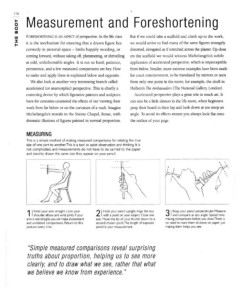
          MEASURING

          This is a simple method of making measured comparisons for relating the true
          size of one part to another This is a tool to assist observation and thinking. It is
          not complicated, and measurements do not have to be carried to the paper
          and slavishly drawn the same size they appear on your pencil.

          1Hold your arm straight. Lock your                  2 Hold your pencil upright. Align the top      3 Keep your pencil perpendicular Measure
                  shoulder; elbow, and wrist joints. If your        with a point on your subject. Close one         and compare at any angle. Spend time
           arm is not straight, you will make inconsistent    eye. Move the tip of your thumb down to a      making comparisons before you draw.There is
           and unrelated comparisons. Return to this          second chosen point. The length of exposed     no need to mark them all down on paper; just
           posture every time.                                pencil is your measurement.                    making them helps you see.

          "Simple measured comparisons reveal surprising
          truths about proportion, helping us to see more
          clearly, and to draw what we see, rather that what
          we believe we know from experience."

