


Page 156 - sarah-simblet_sketch-book-for-the-artist
P. 156
COSTUME156

   Cloth and Drapery

         E A C H O F T H E S E F I G U R E S is ninety percent cloth. Sculpted  one, and the kneeling abbot is a ghost by comparison.
         folds and patterns of material speak more resolutely of their          Opposite, Keisai Eisen's intense, swirling printed fabrics, with
         wearers than any small glimpses of body we can see.                    their jagged edges, dragons, and snakelike marks, resonate
                                                                                with their wearers startled expression. Below this, Flaxmans
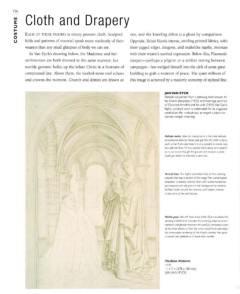
            In Van Eyck's drawing below, the Madonna and her                    sleeper—perhaps a pilgrim or a soldier resting between
         architecture are both dressed in the same manner; her                  campaigns—has wedged himself into the cleft of some great
         marble garment holds u p the infant Christ in a fountain of            building to grab a moment of peace. The quiet stillness of
         compressed line. Above them, the vaulted stone roof echoes             this image is achieved by a masterly economy of stylized line.
         and crowns the moment. Church and deities are drawn as

                                                                                JAN VAN EYCK
                                                                                Flemish oil painter from Limbourg, best known for
                                                                                his G h e n t altarpiece (1432) and marriage p o r t r a i t
                                                                                o f Giovanni Arnolfini and his wife (1434). Van Eyck's
                                                                                highly polished w o r k is c e l e b r a t e d f o r its disguised
                                                                                symbolism. He meticulously arranged subjects to
                                                                                convey deeper meaning.

                                                                                Delicate marks Silver (or metal) point is the most delicate
                                                                                of traditional drawing media (see pp.140-41). With a stylus
                                                                                such as Van Eyck used here, it is only possible to create very
                                                                                thin, delicate lines. He has layered these slowly and carefully
                                                                                so as not to cut through the ground and produce a white
                                                                                mark just where he intended a dark one.

                                                                                Vertical lines The highly controlled lines of this drawing
                                                                                cascade from top to bottom of the image. Their uninterrupted
                                                                                emphasis is entirely vertical. Short and subtle horizontal
                                                                                punctuations are only given in the background by sections
                                                                                of floor, bands around the columns, and implied striation
                                                                                in the stone of the architecture.

                                                                                Marble gown We will never know if Van Eyck considered this
                                                                                drawing unfinished or intended the kneeling abbot to remain
                                                                                transient and ghostly. However, the carefully composed outline
                                                                                of his cloak shows us how the artist would have also begun
                                                                                his immaculate rendering of the Virgin's clothes. Her gown
                                                                                is carved and polished as if made from marble.

                                                                                Maelbeke  Madonna

                                                                                I44I

                                                                                11 x 7 in (278 x 180 m m )

                                                                                JAN V A N EYCK

