


Page 220 - sarah-simblet_sketch-book-for-the-artist
P. 220
ABSTRACT LINES220

  Process and Harmony

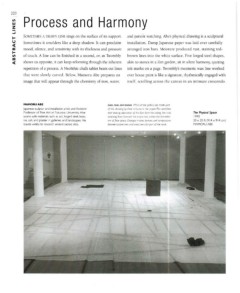
                SOMETIMES A DRAWN LINE sings on the surface of its support.        and patient watching. Abe's physical drawing is a sculptural
                Sometimes it smolders like a deep shadow. It can proclaim          installation. Damp Japanese paper was laid over carefully
                mood, silence, and sensitivity with its thickness and pressure     arranged iron bars. Moisture produced rust, staining red-
                of touch. A line can be finished in a second, or, as Twombly       brown lines into the white surface. Five forged steel shapes,
                shows us opposite, it can keep reforming through the inherent      akin to stones in a Zen garden, sit in silent harmony, quoting
                repetition of a process. A Neolithic chalk tablet bears cut lines  ink marks on a page. Twombly's mesmeric wax line worked
                that were slowly carved. Below, Mamoru Abe prepares an             over house paint is like a signature, rhythmically engaged with
                image that will appear through the chemistry of iron, water,       itself, scrolling across the canvas in an intimate crescendo.

                MAMORU ABE                                                Lines, tone, and texture Pillars of the gallery are made part      The Physical Space
                                                                          of this drawing by their inclusion in the paper. This amplifies    1990
                Japanese sculptor and installation artist, and Assistant  their bracing separation of the floor from the ceiling. Iron rods  3 0 x 30 ft ( 9 1 4 x 9 1 4 cm)
                Professor of Fine A r t at Fukuoka University. Abe        reaching from beneath the paper rest within the framelike          MAMORU ABE
                works with materials such as soil, forged steel, brass,   rim of floor space. Changes in tone, texture, and temperature
                ice, salt, and plaster in galleries and landscapes. He    between paper, iron, and wood are also part of the work.
                travels widely to research ancient sacred sites.

