


Page 227 - sarah-simblet_sketch-book-for-the-artist
P. 227
227

PAUL KLEE
Swiss painter and sculptor
(see also p.31). Klee painted,
drew, philosophized, and wrote
copiously about the natures
and relationships of color
and form. He explained his
polyphonic painting as "a
harmony of several color
voices" searching for a visual
parallel to music.

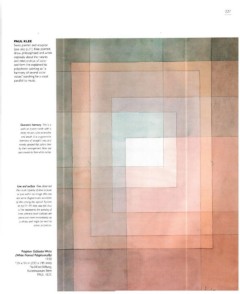
        Geometric harmony This is a
        work on paper made with a
        sharp ink pen, ruler, watercolor,
         and brush. It is a geometric
       harmony of straight lines and
       tonally graded flat colors that
      by their arrangement draw our
     eyes inward to their white center.

    Line and surface Klee observed
   the visual capacity of lines to push
    or pull within an image. We can
   see some diagrammatic examples
   of this among the optical illusions

    on pp.97-99. Klee also felt that
     a line represents the passing of
     time, whereas tonal surfaces are
      perceived more immediately as
       a whole, and might be read as

                          active or passive.

        Polyphon Gefasstes Weiss
 (White Framed Polyphonically)

                                 1930
 131/8x95/8in (333 x 245 mm)

                Paul-Klee-Stiftung,
              Kunstmuseum Bern

                        PAUL KLEE

