


Page 78 - sarah-simblet_sketch-book-for-the-artist
P. 78
ARCHITECTURE78 Creating an Imaginary Space

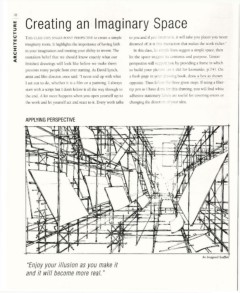
              THIS CLASS USES SINGLE-POINT PERSPECTIVE t o c r e a t e a s i m p l e  to you and if you listen to it, it will take you places you never

              imaginary room. It highlights the importance of having faith            dreamed of; it is  interaction that makes the work richer."
              in your imagination and trusting your ability to invent. The
              mistaken belief that we should know exactly what our                    In this class, let simple lines suggest a simple space, then
              finished drawings will look like before we make them
              prevents many people from ever starting. As David Lynch,                let the space suggest its contents and purpose. Linear
              artist and film director, once said: "I never end up with what
              I set out to do, whether it is a film or a painting. I always           perspective will support you by providing a frame in which
              start with a script but I don't follow it all the way through to
              the end. A lot more happens when you open yourself up to                to b u i l d your picture as it did for Leonardo, p . 7 4 ) . O n
              the work and let yourself act and react to it. Every work talks
                                                                                      a fresh page in your drawing book, draw a box as shown

                                                                                      opposite. Then follow the three given steps. If using a fiber-

                                                                                      tip pen as I have done for this drawing, you will find white

                                                                                      adhesive stationery labels are useful for covering errors or

                                                                                      changing the direction of your idea.

              APPLYING PERSPECTIVE

                                                                                                                            An Imagined Scaffold

              "Enjoy your illusion as you make it
              and it will become more real."

