


Page 19 - 60 Years Generating National Statistics
P. 19
Chronology
                                                                            History of the Department:
                                                                            1965  The  Statistics  Act,  1965  was  passed  by  the
                                                                                  Parliament and the Statistics Ordinance 1949
                                                                                  was repealed. Under this Act, the Bureau of
                                                                                  Statistics was to be known as the Department
                                                                                  of  Statistics.  The  new  act  was  more
                                                                                  comprehensive  and  it  further  strengthened
                                                                                  the  authority  of  the  Department  to  collect
                                                                                  statistics.
                                                                                  The  Bureau  of  Statistics,  Sarawak  and  the
                                                                                  Department  of  Statistics,  Sabah  became
                                                                                  branches  of  the  Department  of  Statistics,
                                                                                  Malaysia.
                                                                                  The  Headquarters  comprised  12  divisions  as
                                                                                  follows:
                                                                                  - Administration Division;
                                                                                  - Coordination Division;
                                                                                  - Data Processing Division;
                                                                                  - Industry Division;
                                                                                  - National Income Division;
                                                                                  - Trade Division;
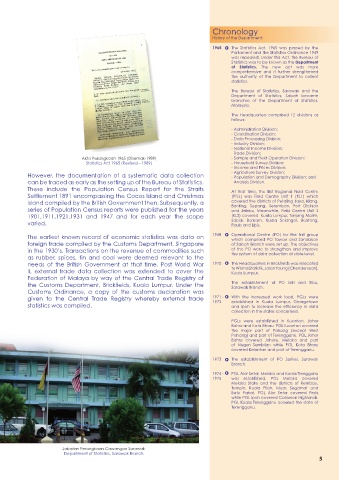
                              Akta Perangkaan 1965 (Disemak-1989)                 - Sample and Field Operation Division;
                               Statistics Act 1965 (Revised – 1989)               - Household Survey Division;
                                                                                  - Income and Prices Division;
           However,  the  documentation  of  a  systematic  data  collection      - Agriculture Survey Division;
                                                                                  - Population and Demography Division; and
           can be traced as early as the setting up of the Bureau of Statistics.   - Analysis Division.
           These  include  the  Population  Census  Report  for  the  Straits     At  that  time,  the  first  Regional  Field  Centre
           Settlement 1891 encompassing the Cocos Island and Christmas            (PGL)  was  Field  Centre  Unit  1  (KL1)  which
           Island compiled by the British Government then. Subsequently, a        covered the districts of Petaling Jaya, Klang,
                                                                                  Banting,  Sepang,  Seremban,  Port  Dickson
           series of Population Census reports were published for the years       and  Jelebu.  Meanwhile,  Field  Centre  Unit  2
           1901,1911,1921,1931  and  1947  and  for  each  year  the  scope       (KL2) covered  Kuala Lumpur, Tanjung Malim,
           varied.                                                                Sabak  Bernam,  Kuala  Selangor,  Bentong,
                                                                                  Raub and Lipis.
           The  earliest  known  record  of  economic  statistics  was  data  on   1968  Operational  Centre  (PO)  for  the  first  group
                                                                                  which  comprised  PO  Tawau  and  Sandakan
           foreign trade compiled by the Customs Department, Singapore            of Sabah Branch were set up. The objectives
           in the 1930’s. Transactions on the revenue of commodities such         of  the  PO  were  to  strengthen  and  improve
                                                                                  the system of data collection at state level.
           as  rubber,  spices,  tin  and  coal  were  deemed  relevant  to  the
           needs  of  the  British  Government  at  that  time.  Post  World  War   1970  The Headquarters in Brickfields was relocated
           II,  external  trade  data  collection  was  extended  to  cover  the   to Wisma Statistik, Jalan Young (Chenderasari),
                                                                                  Kuala Lumpur.
           Federation of Malaya by way of the Central Trade Registry of
           the  Customs  Department,  Brickfields,  Kuala  Lumpur.  Under  the    The  establishment  of  PO  Miri  and  Sibu,
                                                                                  Sarawak Branch.
           Customs  Ordinance,  a  copy  of  the  customs  declaration  was
           given  to  the  Central  Trade  Registry  whereby  external  trade   1971 -  With  the  increased  work  load,  PGLs  were
                                                                                  established  in  Kuala  Lumpur,  Georgetown
                                                                            1972
           statistics was compiled.                                               and  Ipoh  to  increase  the  efficiency  in  data
                                                                                  collection in the states concerned.
                                                                                  PGLs  were  established  in  Kuantan,  Johor
                                                                                  Bahru and Kota Bharu. PGL Kuantan covered
                                                                                  the  major  part  of  Pahang  (except  West
                                                                                  Pahang) and part of Terengganu. PGL Johor
                                                                                  Bahru  covered  Johore,  Melaka  and  part
                                                                                  of  Negeri  Sembilan  while  PGL  Kota  Bharu
                                                                                  covered Kelantan and part of Terengganu.
                                                                            1973  The  establishment  of  PO  Sarikei,  Sarawak
                                                                                  Branch.
                                                                            1974 -  PGL Alor Setar, Melaka and Kuala Trengganu
                                                                            1975  was  established.  PGL  Melaka  covered
                                                                                  Melaka  State  and  the  districts  of  Rembau,
                                                                                  Tampin,  Kuala  Pilah,  Muar,  Segamat  and
                                                                                  Batu  Pahat.  PGL  Alor  Setar  covered  Perlis
                                                                                  while PGL Ipoh covered Cameron Highlands.
                                                                                  PGL Kuala Terengganu covered the state of
                                                                                  Terengganu.


                       Jabatan Perangkaan Cawangan Sarawak
                        Department of Statistics, Sarawak Branch
                                                                                                                 5 5

