


Page 18 - #Erast@gram+ n°4
P. 18
Culture


            Lithuanian Easter Traditions


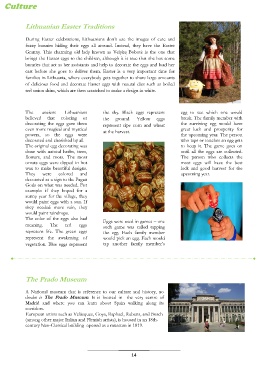
            During  Easter  celebrations,  Lithuanians  don’t  use  the  images  of  cute  and
            fuzzy  bunnies  hiding  their  eggs  all  around.  Instead,  they  have  the  Easter
            Granny.  This  charming  old  lady  known  as  Velykų  Bobutė  is  the  one  that
            brings the Easter eggs to the children, although it is true that she has some
            bunnies that act as her assistants and help to decorate the eggs and load her
            cart  before  she  goes  to  deliver  them.  Easter  is  a  very  important  time  for
            families in Lithuania, where everybody gets together to share large amounts
            of delicious food and decorate Easter eggs with natural dies such as boiled
            red onion skins, which are then scratched to make a design in white.


            The     ancient   Lithuanians      the  sky.  Black  eggs  represent   egg  to  see  which  one  would
            believed  that  coloring  or       the   ground.   Yellow   eggs     break. The family member with
            decorating  the  eggs  gave  them   represent  ripe  corn  and  wheat   the  surviving  egg  would  have
            even more magical and mystical     at the harvest.                   great  luck  and  prosperity  for
            powers,  so  the  eggs  were                                         the upcoming year. The person
            decorated and cherished by all.                                      who taps or touches an egg gets
            The original egg decorating was                                      to  keep  it.  The  game  goes  on
            done  with  natural  herbs,  trees,                                  until  all  the  eggs  are  collected.
            flowers,  and  roots.  The  most                                     The  person  who  collects  the
            ornate eggs were dipped in hot                                       most  eggs  will  have  the  best
            wax to  make  beautiful  designs.                                    luck  and  good  harvest  for  the
            They    were   colored   and                                         upcoming year.
            decorated as a sign to the Pagan
            Gods on what was needed. For
            example:  if  they  hoped  for  a
            sunny year for the village, they
            would paint eggs with a sun. If
            they  needed  more  rain,  they
            would paint raindrops.
            The color of the eggs also had     Eggs were used in games – one
            meaning.   The    red   eggs       such  game  was  called  tapping
            represent  life.  The  green  eggs   the  egg.  Each  family  member
            represent  the  awakening  of      would pick an egg. Each would
            vegetation.  Blue  eggs  represent   tap  another  family  member’s


            The Prado Museum

            A  National  museum  that  is  reference  to  our  culture  and  history,  no
            doubt  is  The  Prado  Museum.  It  is  located  in    the  very  centre  of
            Madrid  and  where  you  can  learn  about  Spain  walking  along  its
            corridors.
            European artists such as Velázquez, Goya, Raphael, Rubens, and Bosch
            (among other major Italian and Flemish artists), is housed in an 18th-
            century Neo-Classical building  opened as a museum in 1819.


                                                           14

