


Page 7 - Gazette1_63
P. 7
\ EPTS GAZETTE


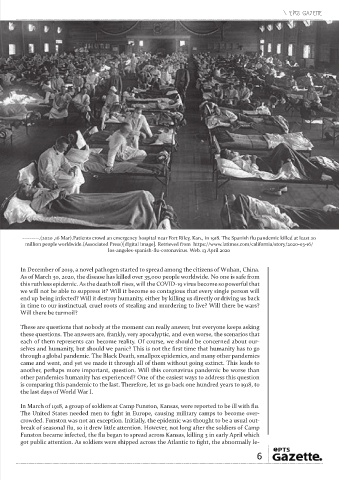
         ---------.(2020 ,16 Mar).Patients crowd an emergency hospital near Fort Riley, Kan., in 1918. The Spanish flu pandemic killed at least 20
          million people worldwide.(Associated Press)[digital image]. Retrieved from  https://www.latimes.com/california/story/2020-03-16/
                                       los-angeles-spanish-flu-coronavirus. Web. 13 April 2020


        In December of 2019, a novel pathogen started to spread among the citizens of Wuhan, China.
        As of March 30, 2020, the disease has killed over 35,000 people worldwide. No one is safe from
        this ruthless epidemic. As the death toll rises, will the COVID-19 virus become so powerful that
        we will not be able to suppress it? Will it become so contagious that every single person will
        end up being infected? Will it destroy humanity, either by killing us directly or driving us back
        in time to our instinctual, cruel roots of stealing and murdering to live? Will there be wars?
        Will there be turmoil?

        These are questions that nobody at the moment can really answer, but everyone keeps asking
        these questions. The answers are, frankly, very apocalyptic, and even worse, the scenarios that
        each of them represents can become reality. Of course, we should be concerned about our-
        selves and humanity, but should we panic? This is not the first time that humanity has to go
        through a global pandemic. The Black Death, smallpox epidemics, and many other pandemics
        came and went, and yet we made it through all of them without going extinct. This leads to
        another, perhaps more important, question. Will this coronavirus pandemic be worse than
        other pandemics humanity has experienced? One of the easiest ways to address this question
        is comparing this pandemic to the last. Therefore, let us go back one hundred years to 1918, to
        the last days of World War I.

        In March of 1918, a group of soldiers at Camp Funston, Kansas, were reported to be ill with flu.
        The United States needed men to fight in Europe, causing military camps to become over-
        crowded. Funston was not an exception. Initially, the epidemic was thought to be a usual out-
        break of seasonal flu, so it drew little attention. However, not long after the soldiers of Camp
        Funston became infected, the flu began to spread across Kansas, killing 3 in early April which
        got public attention. As soldiers were shipped across the Atlantic to fight, the abnormally le-
                                                                                           6

