


Page 8 - Gazette1_63
P. 8
STUDENT'S MAGAZINE \


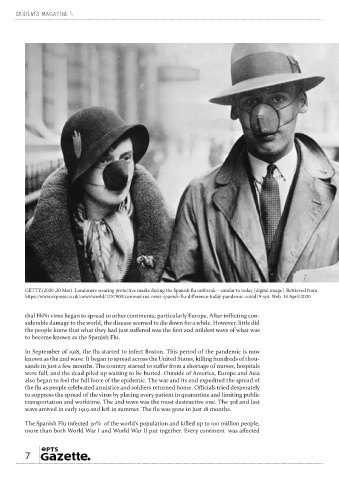
          GETTY.(2020 ,20 Mar). Londoners wearing protective masks during the Spanish flu outbreak – similar to today [digital image]. Retrieved from
          https://www.express.co.uk/news/world/1257900/coronavirus-news-spanish-flu-difference-today-pandemic-covid19-spt. Web. 14 April 2020


          thal H1N1 virus began to spread to other continents, particularly Europe. After inflicting con-
          siderable damage to the world, the disease seemed to die down for a while. However, little did
          the people know that what they had just suffered was the first and mildest wave of what was
          to become known as the Spanish Flu.

          In September of 1918, the flu started to infect Boston. This period of the pandemic is now
          known as the 2nd wave. It began to spread across the United States, killing hundreds of thou-
          sands in just a few months. The country started to suffer from a shortage of nurses, hospitals
          were full, and the dead piled up waiting to be buried. Outside of America, Europe and Asia
          also began to feel the full force of the epidemic. The war and its end expedited the spread of
          the flu as people celebrated armistice and soldiers returned home. Officials tried desperately
          to suppress the spread of the virus by placing every patient in quarantine and limiting public
          transportation and worktime. The 2nd wave was the most destructive one. The 3rd and last
          wave arrived in early 1919 and left in summer. The flu was gone in just 18 months.

          The Spanish Flu infected 30%  of the world’s population and killed up to 100 million people,
          more than both World War I and World War II put together. Every continent  was affected


          7

