


Page 152 - REPOWER REFERENCE GUIDE (2020)
P. 152
Fuel System

        Antisiphon Valve
           U.S. boating standards and regulations specify that an antisiphon valve be used on any application where any portion of the
           fuel line falls below the top of the fuel tank. This valve serves to minimize the amount of fuel that could leak into the bilge of the
           boat in the event of a fuel system leak. A mechanical antisiphon valve or an electrically operated fuel shut‑off valve is
           acceptable for this purpose and should be installed in accordance with industry standards and the manufacturer's instructions.
           The mechanical valve must be carefully sized to the fuel pressure head produced in a given application (a function of the fuel
           level height between the lowest and highest point in the system). The valve must check the flow of fuel when the engine is not
           running, yet avoid excessive restriction when the engine is operational. An overall fuel system pressure drop of 6.9 kPa (1 psi)
           or less is desirable but may not be achievable in all cases. In these cases, it is recommended that an electric fuel shut‑off valve
           be used.
        Fuel Lines and Fittings
           •   U.S. boating standards and regulations specify the sole use of USCG Type A1 fuel lines in the engine compartment or in
               any location in the boat where a break in the line could result in a discharge of 150 cc (5 oz) of fuel in 2‑1/2 minutes.
           •   To meet 2007 California Air Resources Board regulations, any boat manufactured for sale, sold or offered for sale in
               California, or that is introduced, delivered or imported into California for introduction into commerce must use low
               permeation fuel hose from the primary connection of the fuel tank to engine.
           •   Low permeation fuel hose is defined as not exceeding 15 g/m²/24 h with CE10 fuel at 23° C as specified in SAE J 1527—
               Marine Fuel Hoses.
           •   The minimum fuel line and fitting sizes should be used. Larger sizes may be required on applications with longer fuel lines
               or numerous fittings.

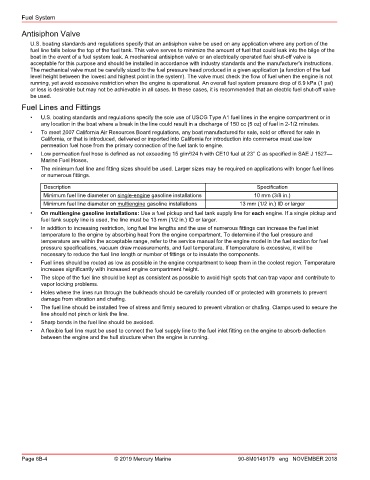
               Description                                                            Specification
               Minimum fuel line diameter on single‑engine gasoline installations    10 mm (3/8 in.)
               Minimum fuel line diameter on multiengine gasoline installations  13 mm (1/2 in.) ID or larger
           •   On multiengine gasoline installations: Use a fuel pickup and fuel tank supply line for each engine. If a single pickup and
               fuel tank supply line is used, the line must be 13 mm (1/2 in.) ID or larger.
           •   In addition to increasing restriction, long fuel line lengths and the use of numerous fittings can increase the fuel inlet
               temperature to the engine by absorbing heat from the engine compartment. To determine if the fuel pressure and
               temperature are within the acceptable range, refer to the service manual for the engine model in the fuel section for fuel
               pressure specifications, vacuum draw measurements, and fuel temperature. If temperature is excessive, it will be
               necessary to reduce the fuel line length or number of fittings or to insulate the components.
           •   Fuel lines should be routed as low as possible in the engine compartment to keep them in the coolest region. Temperature
               increases significantly with increased engine compartment height.
           •   The slope of the fuel line should be kept as consistent as possible to avoid high spots that can trap vapor and contribute to
               vapor locking problems.
           •   Holes where the lines run through the bulkheads should be carefully rounded off or protected with grommets to prevent
               damage from vibration and chafing.
           •   The fuel line should be installed free of stress and firmly secured to prevent vibration or chafing. Clamps used to secure the
               line should not pinch or kink the line.
           •   Sharp bends in the fuel line should be avoided.
           •   A flexible fuel line must be used to connect the fuel supply line to the fuel inlet fitting on the engine to absorb deflection
               between the engine and the hull structure when the engine is running.


        Page 6B-4                      © 2019 Mercury Marine                    90-8M0149179 eng NOVEMBER 2018

