


Page 50 - REPOWER REFERENCE GUIDE (2020)
P. 50
Propeller Selection
        Gasoline Engine Propeller Selection

           NOTE: A CD‑ROM called Everything You Need to Know About Propellers is available from Mercury Precision Parts and
           Accessories. This full‑color book provides the latest in propellers, how they work, types, design and manufacturing, how to
           select the proper propeller for a given application, and answers to many commonly asked questions about boating
           performance. Another great resource is the Propeller Selector (http://www.mercurymarine.com/propellers/prop‑selector/#)
           found on the Mercury Marine website.
        Engine Wide‑Open Throttle (WOT) RPM Range

                                                         NOTICE

            Operating the engine with the wrong propeller installed can limit power, increase fuel consumption, overheat the engine, or
            cause internal powerhead damage. Choose a propeller that allows the engine to operate at the specified wide open throttle
            RPM.
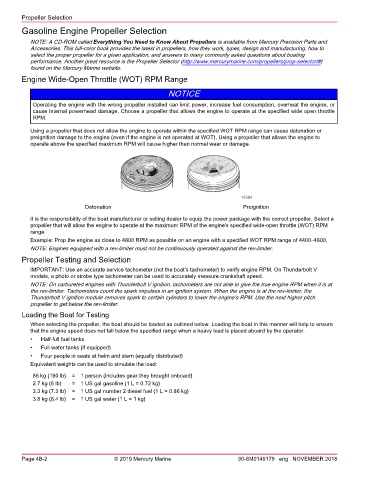
           Using a propeller that does not allow the engine to operate within the specified WOT RPM range can cause detonation or
           preignition damage to the engine (even if the engine is not operated at WOT). Using a propeller that allows the engine to
           operate above the specified maximum RPM will cause higher than normal wear or damage.


                                                                                 14394
                             Detonation                                          Preignition
           It is the responsibility of the boat manufacturer or selling dealer to equip the power package with the correct propeller. Select a
           propeller that will allow the engine to operate at the maximum RPM of the engine's specified wide‑open throttle (WOT) RPM
           range.
           Example: Prop the engine as close to 4800 RPM as possible on an engine with a specified WOT RPM range of 4400–4800.
           NOTE: Engines equipped with a rev‑limiter must not be continuously operated against the rev‑limiter.
        Propeller Testing and Selection

           IMPORTANT: Use an accurate service tachometer (not the boat’s tachometer) to verify engine RPM. On Thunderbolt V
           models, a photo or strobe type tachometer can be used to accurately measure crankshaft speed.
           NOTE: On carbureted engines with Thunderbolt V ignition, tachometers are not able to give the true engine RPM when it is at
           the rev‑limiter. Tachometers count the spark impulses in an ignition system. When the engine is at the rev‑limiter, the
           Thunderbolt V ignition module removes spark to certain cylinders to lower the engine’s RPM. Use the next higher pitch
           propeller to get below the rev‑limiter.
        Loading the Boat for Testing
           When selecting the propeller, the boat should be loaded as outlined below. Loading the boat in this manner will help to ensure
           that the engine speed does not fall below the specified range when a heavy load is placed aboard by the operator.
           •   Half‑full fuel tanks
           •   Full water tanks (if equipped)
           •   Four people in seats at helm and stern (equally distributed)
           Equivalent weights can be used to simulate the load:

            86 kg (190 lb)  =  1 person (includes gear they brought onboard)
            2.7 kg (6 lb)  =  1 US gal gasoline (1 L = 0.72 kg)
            3.3 kg (7.3 lb)  =  1 US gal number 2 diesel fuel (1 L = 0.86 kg)
            3.8 kg (8.4 lb)  =  1 US gal water (1 L = 1 kg)


        Page 4B-2                      © 2019 Mercury Marine                    90-8M0149179 eng NOVEMBER 2018

