


Page 52 - REPOWER REFERENCE GUIDE (2020)
P. 52
Propeller Selection

           •   Increased load or weight (additional passengers, pulling skiers)
           •   A dirty boat bottom
           •   Operating at a higher elevation
               NOTE: Additionally, high‑altitude gear sets are recommended for altitudes of 5,000 ft and higher.
           The owner should be advised to recheck the WOT RPM after the first 50 hours of operation to ensure that it is still within the
           specified range. By this time the engine will have completed the break‑in period. There are many variables to the "black art" of
           propping. If you follow the best practices listed below, then you will be way ahead of the curve with years of enjoyable boating.
        Wide‑Open Throttle ‑ RPM

           It is essential for the health of the engine and overall boating enjoyment to prop a boat correctly. Not doing so will limit the boat
           performance, consume more fuel, and severely shorten the useful life of the engine.
           NOTE: As a boat is used it generally becomes heavier. This pulls down the engine speed. If the boat is at the bottom of the
           RPM range when tested, then additional loading reduces engine speed below the recommended propping range. Continued
           operation at too low of an engine speed due to overpropping will result in severe engine damage that is not covered by the
           limited warranty. As a practical matter any choices made to not test and equip a boat within the recommended RPM range is a
           choice to potentially forfeit limited warranty coverage.
           1.  Please be sure to include consideration for prop testing, changes, and gear ratio adjustments when budgeting a repower.
           2.  Gather information about the boat and engine: boat weight (light and heavy), boat speed, engine type, engine HP, and
               number of engines.
           3.  Begin selection by determining the gear ratio to use in the attached charts based upon engine and boat type.
           4.  Select a prop by using the on‑line prop selector for Mercury and MerCruiser products, or the prop charts in this book for the
               Mercury Remanufactured and Quicksilver Plus Series engines.
               NOTE: The following two steps are essential for correct propping. Run the engine repeatedly at WOT for a few seconds,
               even before break‑in, to verify prop selection.
           5.  Test the prop by running at WOT, and target the RPM in the test at the very top of the normal operating range.
           6.  Change prop pitch as necessary to get to a higher engine speed (RPM), if in doubt use the lower pitch prop.
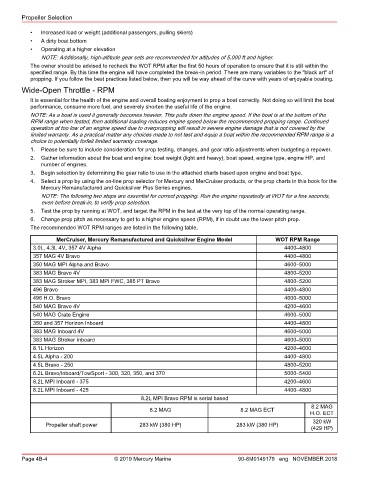
           The recommended WOT RPM ranges are listed in the following table.

                    MerCruiser, Mercury Remanufactured and Quicksilver Engine Model         WOT RPM Range
            3.0L, 4.3L 4V, 357 4V Alpha                                                        4400–4800
            357 MAG 4V Bravo                                                                   4400–4800
            350 MAG MPI Alpha and Bravo                                                        4600–5000
            383 MAG Bravo 4V                                                                   4800–5200
            383 MAG Stroker MPI, 383 MPI FWC, 385 PT Bravo                                     4800–5200
            496 Bravo                                                                          4400–4800
            496 H.O. Bravo                                                                     4600–5000
            540 MAG Bravo 4V                                                                   4200–4600
            540 MAG Crate Engine                                                               4600–5000
            350 and 357 Horizon Inboard                                                        4400–4800
            383 MAG Inboard 4V                                                                 4600–5000
            383 MAG Stroker Inboard                                                            4600–5000
            8.1L Horizon                                                                       4200–4600
            4.5L Alpha ‑ 200                                                                   4400–4800
            4.5L Bravo ‑ 250                                                                   4800–5200
            6.2L Bravo/Inboard/TowSport ‑ 300, 320, 350, and 370                               5000–5400
            8.2L MPI Inboard ‑ 375                                                             4200–4600
            8.2L MPI Inboard ‑ 425                                                             4400–4800
                                                8.2L MPI Bravo RPM is serial based
                                                                                                        8.2 MAG
                                                   8.2 MAG                       8.2 MAG ECT
                                                                                                        H.O. ECT
                Propeller shaft power          283 kW (380 HP)                 283 kW (380 HP)          320 kW
                                                                                                        (429 HP)


        Page 4B-4                      © 2019 Mercury Marine                    90-8M0149179 eng NOVEMBER 2018

