


Page 108 - Science Class 6 Times Publication
P. 108
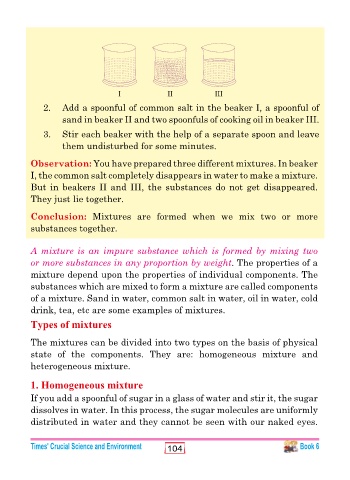
2.   Add a spoonful of common salt in the beaker I, a spoonful of
                   sand in beaker II and two spoonfuls of cooking oil in beaker III.

             3.   Stir each beaker with the help of a separate spoon and leave
                   them undisturbed for some minutes.

          Observation: You have prepared three different mixtures. In beaker
          I, the common salt completely disappears in water to make a mixture.
          But in beakers II and III, the substances do not get disappeared.
          They just lie together.

          Conclusion:  Mixtures are formed when we mix two or more

          substances together.


          A mixture is an impure substance which is formed by mixing two
          or more substances in any proportion by weight. The properties of a
          mixture depend upon the properties of individual components. The
          substances which are mixed to form a mixture are called components
          of a mixture. Sand in water, common salt in water, oil in water, cold
          drink, tea, etc are some examples of mixtures.
          Types of mixtures


          The mixtures can be divided into two types on the basis of physical
          state of the components. They are: homogeneous mixture and
          heterogeneous mixture.

          1. Homogeneous mixture

          If you add a spoonful of sugar in a glass of water and stir it, the sugar
          dissolves in water. In this process, the sugar molecules are uniformly
          distributed in water and they cannot be seen with our naked eyes.


          Times' Crucial Science and Environment  104                                 Book 6

