


Page 109 - Science Class 6 Times Publication
P. 109
We can see only water in the glass, i.e. the solid state of sugar has
got lost in water and we can see only the liquid state. The mixture,
thus obtained, is called homogeneous mixture.
A mixture of two or more substances in which one component
completely disappears in another is called homogeneous mixture. In
such mixture, the particles of the solute are uniformly distributed in
the solvent and cannot be seen with the naked eyes. A homogeneous
mixture is also known as solution. For example, brine (salt solution),
syrup (sugar solution), alcohol in water, soda water, fruit juice, etc
are the examples of homogeneous mixtures.
Solution
A solution is a homogeneous mixture of two or more substances. In
other words, it may be dened as the homogeneous mixture of solute
and solvent. The size of the particles of the components in solution
-7
is 10 cm or less.
Solvent + Solute = Solution
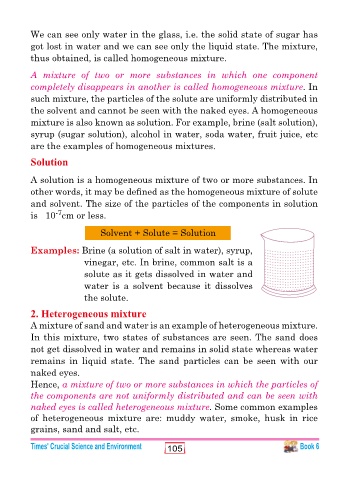
Examples: Brine (a solution of salt in water), syrup,
vinegar, etc. In brine, common salt is a
solute as it gets dissolved in water and
water is a solvent because it dissolves
the solute.
2. Heterogeneous mixture
A mixture of sand and water is an example of heterogeneous mixture.
In this mixture, two states of substances are seen. The sand does
not get dissolved in water and remains in solid state whereas water
remains in liquid state. The sand particles can be seen with our
naked eyes.
Hence, a mixture of two or more substances in which the particles of
the components are not uniformly distributed and can be seen with
naked eyes is called heterogeneous mixture. Some common examples
of heterogeneous mixture are: muddy water, smoke, husk in rice
grains, sand and salt, etc.
Times' Crucial Science and Environment 105 Book 6

