


Page 11 - Science Class 6 Times Publication
P. 11
Measurement of length

          The shortest distance between any two points is called length.  The
          SI unit of length is metre (m). Different instruments can be used to
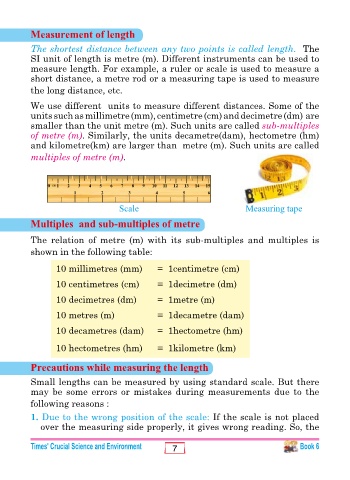
          measure length. For example, a ruler or scale is used to measure a
          short distance, a metre rod or a measuring tape is used to measure
          the long distance, etc.

          We use different  units to measure different distances. Some of the
          units such as millimetre (mm), centimetre (cm) and decimetre (dm)  are
          smaller than the unit metre (m). Such units are called sub-multiples
          of metre (m). Similarly, the units decametre(dam), hectometre (hm)
          and kilometre(km) are larger than  metre (m). Such units are called
          multiples of metre (m).


               0 cm 1  2  3  4  5  6  7  8  9  10  11  12  13  14  15
                      1       2      3       4       5      6
                                   Scale                               Measuring tape
          Multiples  and sub-multiples of metre


          The relation of metre (m) with its sub-multiples and multiples is
          shown in the following table:

                 10 millimetres (mm)          =  1centimetre (cm)
                 10 centimetres (cm)          =  1decimetre (dm)

                 10 decimetres (dm)           =  1metre (m)

                 10 metres (m)                =  1decametre (dam)

                 10 decametres (dam)   =  1hectometre (hm)

                 10 hectometres (hm)          =  1kilometre (km)

          Precautions while measuring the length

          Small lengths can be measured by using standard scale. But there
          may be some errors or mistakes during measurements due to the
          following reasons :

          1. Due to the wrong position of the scale: If the scale is not placed
             over the measuring side properly, it gives wrong reading. So, the

          Times' Crucial Science and Environment  7                                   Book 6

