


Page 136 - Science Class 6 Times Publication
P. 136
Non-metals

          Several non-metals are gases. The non-metals which exist in solid
          state are brittle. They are not as hard as metals. Some non-metals
          exist in liquid state. The non-metals are not malleable and ductile.
          They  do  not  conduct  electricity.  But  graphite  is  a  non-metal  that
          conducts electricity. Hydrogen, helium, carbon, oxygen, nitrogen,
          phosphorus, sulphur, etc are some non-metals.


          The common properties of non-metals can be summarized as follows:

             1.   Non-metals are found in all three states, i.e., solid, liquid and
                   gas at ordinary temperature.
             2.   They are brittle, i.e., they are not malleable and ductile.
             3.   They do not conduct heat and electricity.

             4.   Non-metals do not have lustre. But iodine and graphite are
                   the non-metals with lustre.
             5.   Non-metals are non-sonorous.
             6.   They usually have low melting and boiling points.

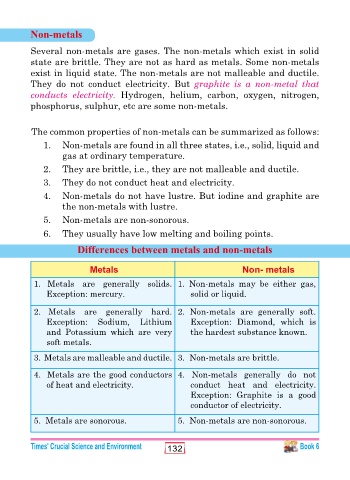
                       Differences between metals and non-metals


                           Metals                                          Non- metals
           1.  Metals are generally solids.  1. Non-metals may be either gas,
              Exception: mercury.                      solid or liquid.

           2.  Metals are generally hard.  2. Non-metals are generally soft.
              Exception: Sodium, Lithium               Exception:  Diamond,  which  is
              and Potassium which are very             the hardest substance known.
              soft metals.
           3.  Metals are malleable and ductile. 3.  Non-metals are brittle.


           4.  Metals are the good conductors  4. Non-metals generally do not
              of heat and electricity.                 conduct heat and electricity.
                                                       Exception: Graphite is a good
                                                       conductor of electricity.

           5.  Metals are sonorous.                5.  Non-metals are non-sonorous.


          Times' Crucial Science and Environment  132                                 Book 6

