


Page 137 - Science Class 6 Times Publication
P. 137
Metalloids

          The elements which show the properties common to both metals and
          non-metals  are  called  metalloids.  The  metalloids  resemble  metals
          in some of their properties while they resemble non-metals in other
          properties. Silicon, arsenic, germanium, etc are some metalloids.
          Some of the common properties of metalloids are as follows:

             a.   Metalloids are either solid or liquid at ordinary temperature.
             b.   They are poor conductors of heat and electricity.

             c.   They are found in powder form.
             d.   They have metallic lustre.

             e.   They are not malleable and ductile.

          Alloys

          When metals are heated strongly, they melt to turn into liquid state.
          The liquid states of metals can be mixed with each other to form a
          homogeneous mixture. The mixture then becomes
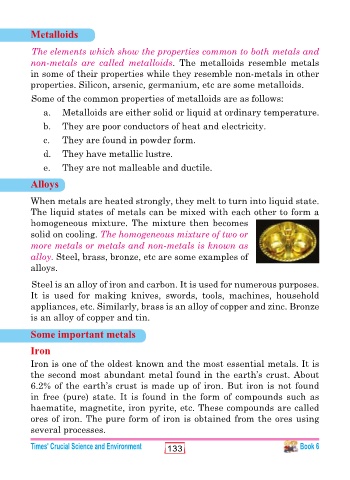
          solid on cooling. The homogeneous mixture of two or
          more metals or metals and non-metals is known as
          alloy. Steel, brass, bronze, etc are some examples of
          alloys.

          Steel is an alloy of iron and carbon. It is used for numerous purposes.
          It  is  used  for  making  knives,  swords,  tools,  machines,  household
          appliances, etc. Similarly, brass is an alloy of copper and zinc. Bronze
          is an alloy of copper and tin.

          Some important metals

          Iron

          Iron is one of the oldest known and the most essential metals. It is
          the second most abundant metal found in the earth’s crust. About
          6.2% of the earth’s crust is made up of iron. But iron is not found
          in free (pure) state. It is found in the form of compounds such as
          haematite, magnetite, iron pyrite, etc. These compounds are called
          ores of iron. The pure form of iron is obtained from the ores using
          several processes.

          Times' Crucial Science and Environment  133                                 Book 6

