


Page 56 - DAX-Formula-Reference-Guide-Enterprise-DNA_Neat
P. 56
DAX Formulas Reference Guide  |  Statistical Functions (DAX)


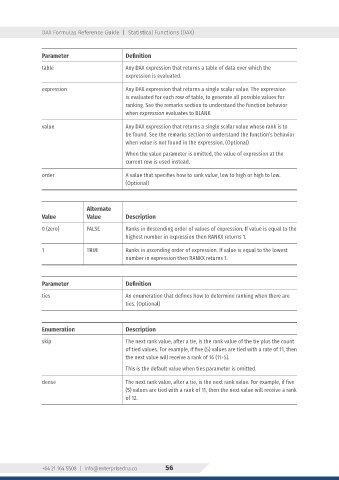
                Parameter                    Definition
                table                        Any DAX expression that returns a table of data over which the
                                             expression is evaluated.

                expression                   Any DAX expression that returns a single scalar value. The expression
                                             is evaluated for each row of table, to generate all possible values for
                                             ranking. See the remarks section to understand the function behavior
                                             when expression evaluates to BLANK.

                value                        Any DAX expression that returns a single scalar value whose rank is to
                                             be found. See the remarks section to understand the function’s behavior
                                             when value is not found in the expression. (Optional)

                                             When the value parameter is omitted, the value of expression at the
                                             current row is used instead.

                order                        A value that specifies how to rank value, low to high or high to low.
                                             (Optional)


                                Alternate
                Value           Value        Description
                0 (zero)        FALSE        Ranks in descending order of values of expression. If value is equal to the
                                             highest number in expression then RANKX returns 1.

                1               TRUE         Ranks in ascending order of expression. If value is equal to the lowest
                                             number in expression then RANKX returns 1.


                Parameter                    Definition
                ties                         An enumeration that defines how to determine ranking when there are
                                             ties. (Optional)


                Enumeration                  Description
                skip                         The next rank value, after a tie, is the rank value of the tie plus the count
                                             of tied values. For example, if five (5) values are tied with a rate of 11, then
                                             the next value will receive a rank of 16 (11+5).

                                             This is the default value when ties parameter is omitted.

                dense                        The next rank value, after a tie, is the next rank value. For example, if five
                                             (5) values are tied with a rank of 11, then the next value will receive a rank
                                             of 12.


                +64 21 164 5508  |  info@enterprisedna.co  56

