


Page 177 - Math Smart - 7
P. 177
CHAPTER 8.1
                                                                                             In this chapter

                                                                                          Pupils should be able to:
        Understanding Fractions                                                           •    understand and use

                                                                                              fraction notation
                                                                                              recognising that
       8.1.1  Parts of 0 whole                                                                fractions are several
                                                                                              parts of one whole

       ^ and ^ are examples of fractions. They are parts of a whole.
        A fraction has a numerator and a denominator.
                                                                                         O         Spotlight
       The number above is called the numerator.
       The number below is called the denominator.
                                                                                          The word fraction
                                                                                          comes from the Latin
                                                                                           word "frangere" which
                                                  The denominator shows the
                  parts of a whole                                                         means "to break". The
                                                  number of equal parts a whole is
                  total number of equal parts                                              history of fractions goes
                                                  divided into. The numerator shows
                                                                                           back to the Babylonians
                                                  the number of parts we have.
                                                                                          (who lived where Iraq is
                                                                                          today) and the ancient
                                                                                           Egyptians.
         Example 1


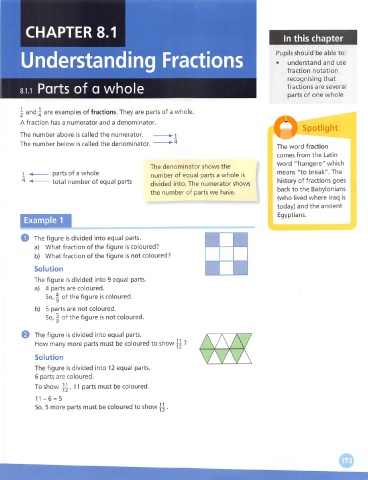
            The figure is divided into equal parts.
            a)  What fraction of the figure is coloured?
            b) What fraction of the figure is not coloured?

            Solution
            The figure Is divided into 9 equal parts.
            a) 4 parts are coloured.
                So, ^ of the figure is coloured.

            b) 5 parts are not coloured.
                So, I of the figure is not coloured.


            The figure is divided into equal parts.
            How many more parts must be coloured to show^
                                                            ?
            Solution
            The figure is divided into 12 equal parts.
            5 parts are coloured.
            To show  . 11 parts must be coloured.
            11-6 = 5
            So, 5 more parts must be coloured to show  .

