


Page 210 - Math Smart - 7
P. 210
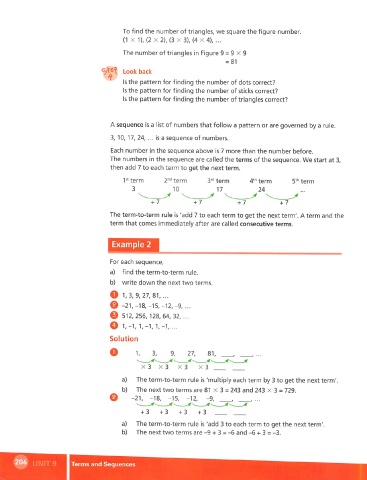
To find the number of triangles, we square the figure number.
                                         (1 XI), (2X2), (3X3), (4X4),...
                                         The number of triangles in Figure 9 = 9x9
                                                                          = 81
                                         Look back
                                         is the pattern for finding the number of dots correct?
                                         Is the pattern for finding the number of sticks correct?
                                         Is the pattern for finding the number of triangles correct?


                                     A sequence is a list of numbers that follow a pattern or are governed by a rule.

                                     3, 10, 17, 24, ... is a sequence of numbers.
                                     Each number in the sequence above is 7 more than the number before.
                                     The numbers in the sequence are called the terms of the sequence. We start at 3,
                                     then add 7 to each term to get the next term.
                                         1" term      2^*^ term     3"^ term      4'^ term      5'^ term
                                            3            10            17            24

                                                  + 7           + 7           + 7           + 7
                                     The term-to-term rule is 'add 7 to each term to get the next term'. A term and the
                                     term that comes immediately after are called consecutive terms.


                                     Example 2


                                     For each sequence,
                                     a)  find the term-to-term rule.
                                     b)  write down the next two terms.

                                     O 1,3,9,27,81,...
                                    O -21,-18,-15,-12,-9, ...
                                         512, 256, 128, 64, 32, ...
                                    O 1.-1,1,-1,1,-1,...
                                     Solution

                                    o        1,   3,    9,    27,   8 1,

                                               x3   x3  X3  x3

                                        a)   The term-to-term rule is 'multiply each term by 3 to get the next term'.
                                         b)  The next two terms are 81 x 3 = 243 and 243 x 3 = 729.
                                    Q       -21,  -18,  -15,  -12,  -9,

                                              + 3    + 3   + 3  +3

                                        a)  The term-to-term rule is 'add 3 to each term to get the next term'.
                                         b)  The next two terms are -9 -h 3 = -6 and -6 + 3 = -3.


            UNIT 9  I Terms and Sequences

