


Page 216 - Math Smart - 7
P. 216
9.2.2 Challenging number sequences


                                     For number patterns that are not directly related to its position in the sequence,
                                     we can compare it with a known number sequence, like the multiples of a
                                     number, perfect squares or cubes.


                                      Example 3

                                     Find the formula for the general term (Tn) of each sequence.
                                     O 4,7, 10, 13, 16,...
                                     @ 1, 6, 11, 16, 21, ...

                                     Solution
                                     o
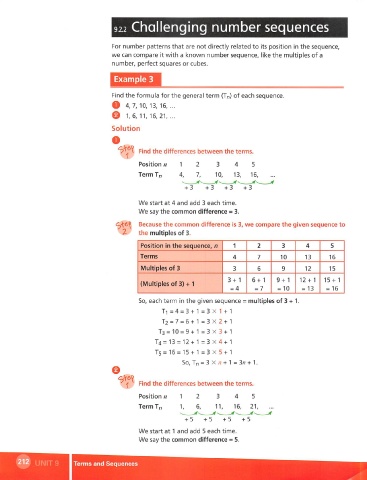
                                              Find the differences between the terms.

                                              Position n   1     2     3     4     5
                                              TermTn       4,    7,    10,   13,  16,


                                              We start at 4 and add 3 each time.
                                              We say the common difference = 3.

                                              Because the common difference is 3, we compare the given sequence to
                                              the multiples of 3.

                                               Position in the sequence, n   1      2       3       4       5
                                              Terms                         4       7       10      13      16
                                               Multiples of 3                3      6       9       12      15

                                                                                              1
                                                                              1
                                                                           3 +     6 +  1  9 +    12+1    15 +  1
                                                               1
                                              (Multiples of 3) +
                                                                            = 4     = 7    = 10    = 13    = 16
                                              So, each term in the given sequence = multiples of 3 + 1.
                                                     Ti = 4 = 3 + 1= 3x1 +  1
                                                      T2 = 7 = 6 + 1= 3x2 +  1
                                                    T3 = 10 = 9 + 1= 3x3 +  1
                                                   T4 = 13 = 12 + 1 =3 X 4 +  1
                                                   T5 = 16 = 15 + 1 =3 X 5 +
                                                                            1
                                                            So, Tn = 3 X /! + 1 = 3/7 + 1.
                                     ©

                                              Find the differences between the terms.
                                         1
                                              Position n   1     2     3     4     5
                                              Term In      1,    6,    11,   16,  21,  ...

                                                             + 5  +5  +5  +5
                                              We start at 1 and add 5 each time.
                                              We say the common difference = 5.


            UIMIT 9  I Terms and Sequences

