


Page 68 - Math Smart - 7
P. 68
CHAPTER 3.4


           In this chapter                        onstructirf^ and

       Pupils should be able to:
       •     construct simple linear
                                              Solving Equations
           equations with integer
           coefficients
       •     solve linear equations
           where unknowns are on
                                      We form equations and solve them in many situations. We can use equations
           one side only
                                      to calculate a phone bill, plan a fundraising event at school or to work out the
                                      price at which I should sell my products to earn a profit if I open a shop.

                                      When we give a value to an algebraic expression, we get an equation. Let us
                                      learn how to formulate and solve equations.


                                      3.4.1 Solving equations using trial


                                            and error


                                     We can use trial and error to determine the value of x that satisfies the
                                     equation.


                                       Example 1


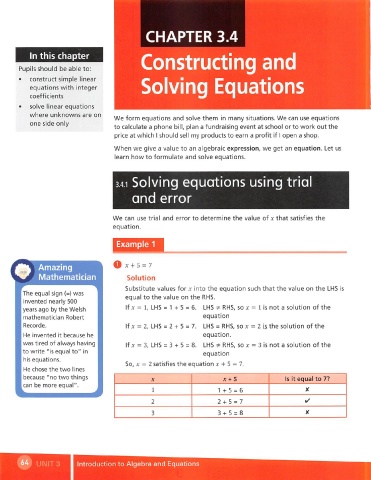
             Amazing                  O x + S = 7
              Mathematician               Solution
                                         Substitute values for x into the equation such that the value on the LHS is
        I The equal sign (=) was
                                         equal to the value on the RHS.
        invented nearly 500
        years ago by the Welsh            If X = 1, LHS = 1+5 = 6.  LHS  RHS, so x = 1 is not a solution of the
                                                                   equation
        mathematician Robert
        Recorde.                          If X = 2, LHS = 2 + 5 = 7.  LHS = RHS, so x = 2 is the solution of the
        He invented it because he                                  equation.
        was tired of always having        If X = 3, LHS = 3 + 5 = 8.  LHS 9^ RHS, so x = 3 is not a solution of the
        to write "is equal to" in
                                                                   equation
         his equations.
                                         So, X = 2 satisfies the equation x + 5 = 7.
        He chose the two lines
         because "no two things
                                                  X                      * + 5               Is it equal to 7?
        can be more equal".
                                                  1                    1 +5 = 6                     X
                                                  2                    2 + 5 = 7                    3
                                                  3                    3 + 5 = 8                    X


             UNITS  I Introduction to Algebra and Equations

