


Page 59 - Elementary Algebra Exercise Book I
P. 59
ELEMENTARY ALGEBRA EXERCISE BOOK I                                               equAtions


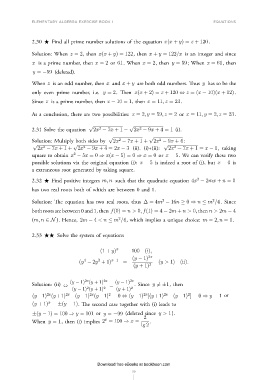
               2.30    Find all prime number solutions of the equation  x(x + y)= z + 120.

               Solution: When  z =2, then  x(x + y) = 122, then  x + y = 122/x  is an integer and since
               x  is a prime number, then  x =2 or  61. When  x =2, then  y = 59; When  x = 61, then

                y = −59 (deleted).

               When z  is an odd number, then x  and x + y  are both odd numbers. Thus  y  has to be the

               only even prime number, i.e.  y =2. Then  x(x + 2) = z + 120 ⇔ z =(x − 10)(x + 12).
               Since  z  is a prime number, then  x − 10 = 1, then  x = 11,z = 23.


               As a conclusion, there are two possibilities:  x =2,y = 59,z =2 or  x = 11,y =2,z = 23.

                                        √                 √
               2.31 Solve the equation    2x − 7x +1 −      2x − 9x +4 = 1 (i).
                                                               2
                                             2
                                                 √                 √
               Solution: Multiply both sides by    2x − 7x +1+       2x − 9x +4:
                                                                        2
                                                      2
                √                 √                                       √
                                                                              2
                                      2
                    2
                  2x − 7x +1+       2x − 9x +4 = 2x − 3 (ii). (i)+(ii):     2x − 7x +1 = x − 1, taking
                                  2
               square to obtain  x − 5x =0 ⇒ x(x − 5) = 0 ⇒ x =0 or  x =5. We can verify these two
               possible solutions via the original equation (i):  x =5 is indeed a root of (i), but  x =0 is
               a extraneous root generated by taking square.
               2.32    Find positive integers  m, n  such that the quadratic equation  4x − 2mx + n =0
                                                                                         2
               has two real roots both of which are between 0 and 1.
                                                                         2
                                                                                               2
               Solution: The equation has two real roots, thus  Δ=4m − 16n ≥ 0 ⇒ n ≤ m /4. Since
               both roots are between 0 and 1, then f(0) = n> 0,f(1) = 4 − 2m + n> 0, then n> 2m − 4
               (m, n ∈ N ). Hence,  2m − 4 <n ≤ m /4, which implies a unique choice:  m =2,n =1.
                                                      2

               2.33     Solve the system of equations


                                              (1 + y) x  = 100 (i),
                                                            (y − 1) 2x
                                             2
                                      4
                                    (y − 2y + 1)  x−1   =              (y> 1) (ii).
                                                            (y + 1) 2
                                       2x
               Solution: (ii)   ⇔  (y − 1) (y + 1) 2x  =  (y − 1) 2x . Since  y �= ±1, then
                                        2
                                 (y − 1) (y + 1) 2   (y + 1) 2
               (y−1) (y+1) −(y−1) (y−1) =0 ⇔ (y−1) [(y+1) −(y−1) ]=0 ⇒ y =1 or
                              2x
                                                                                    2
                                                                 2x
                      2x
                                                 2
                                                                          2x
                                         2x
                      x
               (y + 1) = ±(y − 1). The second case together with (i) leads to
               ±(y − 1) = 100 ⇒ y = 101 or  y = −99 (deleted since  y> 1).
                                                                 2
                                                x
               When  y =1, then (i) implies  2 = 100 ⇒ x =         .
                                                                lg 2


                                            Download free eBooks at bookboon.com
                                                            59

