


Page 303 - Basic Principles of Textile Coloration
P. 303
292 DYEING CELLULOSIC FIBRES WITH DIRECT DYES

                  120

Temperature/oC  100
                                                              2 34
                                                                                                  5

                 80

                60

                       1

                40        20 40 60                                  80 100
                    0

                          Time/min

                    1 Add dyes
                    2 Add 20% of total salt
                    3 Add 30% of total salt
                    4 Add 50% of total salt (final concn 10 g l–1)
                    5 Rinse

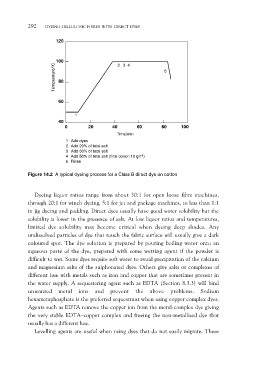
Figure 14.2 A typical dyeing process for a Class B direct dye on cotton

   Dyeing liquor ratios range from about 30:1 for open loose fibre machines,
through 20:1 for winch dyeing, 5:1 for jet and package machines, to less than 1:1
in jig dyeing and padding. Direct dyes usually have good water solubility but the
solubility is lower in the presence of salt. At low liquor ratios and temperatures,
limited dye solubility may become critical when dyeing deep shades. Any
undissolved particles of dye that touch the fabric surface will usually give a dark
coloured spot. The dye solution is prepared by pouring boiling water onto an
aqueous paste of the dye, prepared with some wetting agent if the powder is
difficult to wet. Some dyes require soft water to avoid precipitation of the calcium
and magnesium salts of the sulphonated dyes. Others give salts or complexes of
different hue with metals such as iron and copper that are sometimes present in
the water supply. A sequestering agent such as EDTA (Section 8.3.3) will bind
unwanted metal ions and prevent the above problems. Sodium
hexametaphosphate is the preferred sequestrant when using copper complex dyes.
Agents such as EDTA remove the copper ion from the metal-complex dye giving
the very stable EDTA–copper complex and freeing the non-metallised dye that
usually has a different hue.

   Levelling agents are useful when using dyes that do not easily migrate. These

