


Page 332 - Basic Principles of Textile Coloration
P. 332
Fibre saturation/% owf                             DYEING POLYESTER WITH DISPERSE DYES 321

   When fabrics of PET are heated in water at the boil there is often considerable
shrinkage as the tensions in the filaments relax. The shrinkage may be even
greater at higher temperatures. Fabrics of PET can be dry heat set at 200–225 °C
for 30–60 s. Alternatively, steam heat setting at 130–140 °C for several minutes
is also possible but can cause a loss of strength due to some hydrolysis of the
polyester. Steam setting provides dimensional stability in boiling water but, for
stability to ironing, higher setting temperatures must be used.

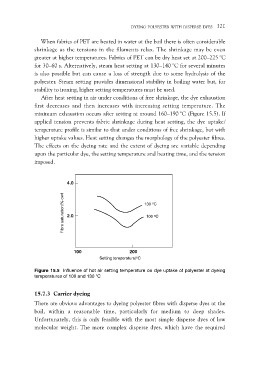
   After heat setting in air under conditions of free shrinkage, the dye exhaustion
first decreases and then increases with increasing setting temperature. The
minimum exhaustion occurs after setting at around 160–190 °C (Figure 15.5). If
applied tension prevents fabric shrinkage during heat setting, the dye uptake/
temperature profile is similar to that under conditions of free shrinkage, but with
higher uptake values. Heat setting changes the morphology of the polyester fibres.
The effects on the dyeing rate and the extent of dyeing are variable depending
upon the particular dye, the setting temperature and heating time, and the tension
imposed.

                     4.0

                                                                                   130 oC

                     2.0 100 oC

                          100 200

                                                 Setting temperature/oC

Figure 15.5 Influence of hot air setting temperature on dye uptake of polyester at dyeing
temperatures of 100 and 130 °C

15.7.3 Carrier dyeing
There are obvious advantages to dyeing polyester fibres with disperse dyes at the
boil, within a reasonable time, particularly for medium to deep shades.
Unfortunately, this is only feasible with the most simple disperse dyes of low
molecular weight. The more complex disperse dyes, which have the required

