


Page 327 - Basic Principles of Textile Coloration
P. 327
316 DISPERSE DYES

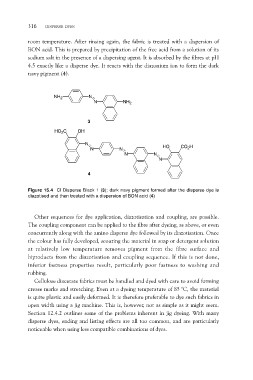
room temperature. After rinsing again, the fabric is treated with a dispersion of
BON acid. This is prepared by precipitation of the free acid from a solution of its
sodium salt in the presence of a dispersing agent. It is absorbed by the fibres at pH
4.5 exactly like a disperse dye. It reacts with the diazonium ion to form the dark
navy pigment (4).

NH2   N

               N NH2

HO2C        3
      OH

      N                  HO CO2H
         NN

               NN

                      N

      4

Figure 15.4 CI Disperse Black 1 (3); dark navy pigment formed after the disperse dye is
diazotised and then treated with a dispersion of BON acid (4)

   Other sequences for dye application, diazotisation and coupling, are possible.
The coupling component can be applied to the fibre after dyeing, as above, or even
concurrently along with the amino disperse dye followed by its diazotisation. Once
the colour has fully developed, scouring the material in soap or detergent solution
at relatively low temperature removes pigment from the fibre surface and
biproducts from the diazotisation and coupling sequence. If this is not done,
inferior fastness properties result, particularly poor fastness to washing and
rubbing.

   Cellulose diacetate fabrics must be handled and dyed with care to avoid forming
crease marks and stretching. Even at a dyeing temperature of 85 °C, the material
is quite plastic and easily deformed. It is therefore preferable to dye such fabrics in
open width using a jig machine. This is, however, not as simple as it might seem.
Section 12.4.2 outlines some of the problems inherent in jig dyeing. With many
disperse dyes, ending and listing effects are all too common, and are particularly
noticeable when using less compatible combinations of dyes.

