


Page 36 - Basic Principles of Textile Coloration
P. 36
FABRIC MANUFACTURE 25

number increases as the yarn thickness increases. Since the tex is a metric unit,
decimal multiples and fractions are used for coarser and finer yarns. The kilotex
(1 ktex = 1000 tex = 1000 g km–1) is used for sliver, and the decitex (1 dtex =
0.1 tex = 0.1 g km–1) for fine yarns and filaments. Note that 1.0 dtex (0.1 g
km–1) is equal to 0.9 denier (0.9 g (9 km)–1).

   Much of the technology used today for yarn production originally developed
from wool and cotton processing. Modern yarn production from natural staple
fibres involves considerable resources because of the large number of operations
involved. Continuous filament yarns have the advantage of being ready for direct
assembly into fabrics. They are also much cleaner than yarns from natural fibres.

2.3 FABRIC MANUFACTURE
The are four major types of textile fabric:
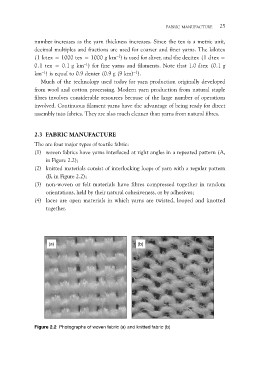
(1) woven fabrics have yarns interlaced at right angles in a repeated pattern (A,

      in Figure 2.2);
(2) knitted materials consist of interlocking loops of yarn with a regular pattern

      (B, in Figure 2.2);
(3) non-woven or felt materials have fibres compressed together in random

      orientations, held by their natural cohesiveness, or by adhesives;
(4) laces are open materials in which yarns are twisted, looped and knotted

      together.

         (a) (b)

Figure 2.2 Photographs of woven fabric (a) and knitted fabric (b)

