


Page 423 - Basic Principles of Textile Coloration
P. 423
412 UNION DYEING

cotton/polyester fabric improves the tensile strength, abrasion resistance and
dimensional stability, while the cotton provides reduced pilling, good moisture
absorbency and wearer comfort. The polyester also minimises the loss of tear
strength and abrasion resistance that occurs on treating cotton with crosslinking
agents in the presence of acid catalysts.

   The four main classes of dyes are:
(1) anionic acid dyes;
(2) cationic dyes;
(3) the various kinds of anionic dyes for cellulosic fibres;
(3) disperse dyes.

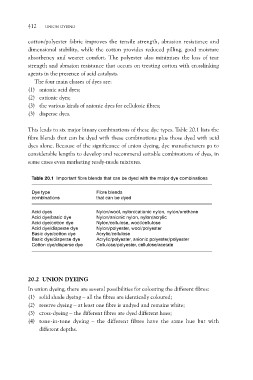
This leads to six major binary combinations of these dye types. Table 20.1 lists the
fibre blends that can be dyed with these combinations plus those dyed with acid
dyes alone. Because of the significance of union dyeing, dye manufacturers go to
considerable lengths to develop and recommend suitable combinations of dyes, in
some cases even marketing ready-made mixtures.

Table 20.1 Important fibre blends that can be dyed with the major dye combinations

Dye type                 Fibre blends
combinations             that can be dyed

Acid dyes                Nylon/wool, nylon/cationic nylon, nylon/urethane
Acid dye/basic dye       Nylon/anionic nylon, nylon/acrylic
Acid dye/cotton dye      Nylon/cellulose, wool/cellulose
Acid dye/disperse dye    Nylon/polyester, wool/polyester
Basic dye/cotton dye     Acrylic/cellulose
Basic dye/disperse dye   Acrylic/polyester, anionic polyester/polyester
Cotton dye/disperse dye  Cellulose/polyester, cellulose/acetate

20.2 UNION DYEING

In union dyeing, there are several possibilities for colouring the different fibres:
(1) solid shade dyeing – all the fibres are identically coloured;
(2) reserve dyeing – at least one fibre is undyed and remains white;
(3) cross-dyeing – the different fibres are dyed different hues;
(4) tone-in-tone dyeing – the different fibres have the same hue but with

      different depths.

