


Page 100 - Elementary_Linear_Algebra_with_Applications_Anton__9_edition
P. 100
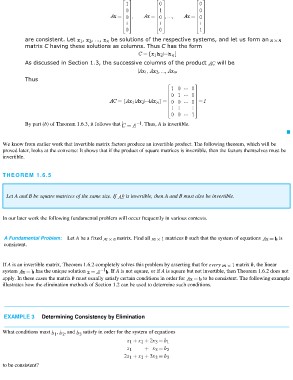
are consistent. Let , , …, be solutions of the respective systems, and let us form an
        matrix C having these solutions as columns. Thus C has the form

        As discussed in Section 1.3, the successive columns of the product will be

        Thus

        By part (b) of Theorem 1.6.3, it follows that  . Thus, A is invertible.

We know from earlier work that invertible matrix factors produce an invertible product. The following theorem, which will be
proved later, looks at the converse: It shows that if the product of square matrices is invertible, then the factors themselves must be
invertible.

THEOREM 1.6.5

Let A and B be square matrices of the same size. If is invertible, then A and B must also be invertible.

In our later work the following fundamental problem will occur frequently in various contexts.

A Fundamental Problem: Let A be a fixed  matrix. Find all  matrices b such that the system of equations                         is
consistent.

If A is an invertible matrix, Theorem 1.6.2 completely solves this problem by asserting that for every    matrix b, the linear

system  has the unique solution          . If A is not square, or if A is square but not invertible, then Theorem 1.6.2 does not

apply. In these cases the matrix b must usually satisfy certain conditions in order for  to be consistent. The following example

illustrates how the elimination methods of Section 1.2 can be used to determine such conditions.

EXAMPLE 3 Determining Consistency by Elimination
What conditions must , , and satisfy in order for the system of equations

to be consistent?

