


Page 99 - Elementary_Linear_Algebra_with_Applications_Anton__9_edition
P. 99
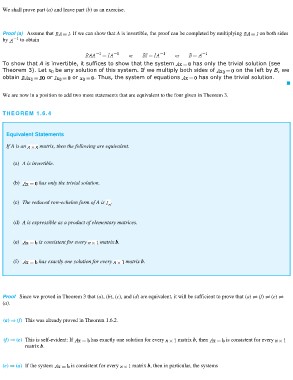
We shall prove part (a) and leave part (b) as an exercise.

Proof (a) Assume that  . If we can show that A is invertible, the proof can be completed by multiplying  on both sides
by to obtain

To show that A is invertible, it suffices to show that the system  has only the trivial solution (see

Theorem 3). Let be any solution of this system. If we multiply both sides of                             on the left by B, we

obtain  or             or . Thus, the system of equations          has only the trivial solution.

We are now in a position to add two more statements that are equivalent to the four given in Theorem 3.

THEOREM 1.6.4

Equivalent Statements
If A is an matrix, then the following are equivalent.

   (a) A is invertible.

   (b) has only the trivial solution.

(c) The reduced row-echelon form of A is .

(d) A is expressible as a product of elementary matrices.
(e) is consistent for every matrix b.
(f) has exactly one solution for every matrix b.

Proof Since we proved in Theorem 3 that (a), (b), (c), and (d) are equivalent, it will be sufficient to prove that (a) (f) (e)
(a).

(a) (f) This was already proved in Theorem 1.6.2.

(f) (e) This is self-evident: If  has exactly one solution for every matrix b, then       is consistent for every
            matrix b.

(e) (a) If the system  is consistent for every matrix b, then in particular, the systems

