


Page 117 - Elementary_Linear_Algebra_with_Applications_Anton__9_edition
P. 117
(b) If A and B are skew-symmetric, then so are , , , and for any scalar k.

(c) Every square matrix A can be expressed as the sum of a symmetric matrix and a skew-symmetric matrix.

Hint Note the identity                               .

     We showed in the text that the product of symmetric matrices is symmetric if and only if the matrices commute. Is the
23. product of commuting skew-symmetric matrices skew-symmetric? Explain.

Note See Exercise 22 for terminology.

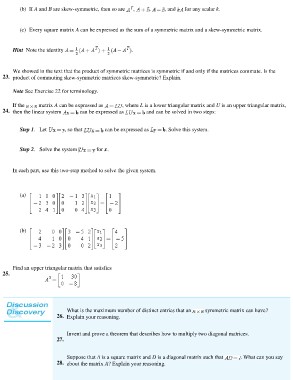
If the matrix A can be expressed as                  , where L is a lower triangular matrix and U is an upper triangular matrix,

24. then the linear system  can be expressed as         and can be solved in two steps:

Step 1. Let                 , so that  can be expressed as         . Solve this system.

Step 2. Solve the system               for x.

In each part, use this two-step method to solve the given system.

(a)

(b)

     Find an upper triangular matrix that satisfies
25.

                  What is the maximum number of distinct entries that an  symmetric matrix can have?
             26. Explain your reasoning.

                  Invent and prove a theorem that describes how to multiply two diagonal matrices.
             27.

                  Suppose that A is a square matrix and D is a diagonal matrix such that  . What can you say
             28. about the matrix A? Explain your reasoning.

