


Page 146 - Elementary_Linear_Algebra_with_Applications_Anton__9_edition
P. 146
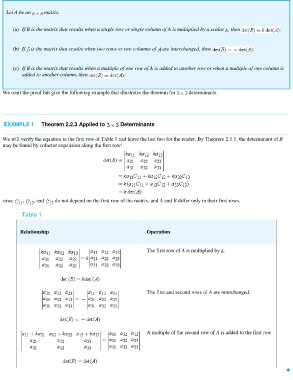
Let A be an matrix.                                                                                                 .
   (a) If B is the matrix that results when a single row or single column of A is multiplied by a scalar , then

(b) If is the matrix that results when two rows or two columns of are interchanged, then                         .

(c) If B is the matrix that results when a multiple of one row of A is added to another row or when a multiple of one column is

added to another column, then       .

We omit the proof but give the following example that illustrates the theorem for determinants.

EXAMPLE 1 Theorem 2.2.3 Applied to  Determinants

We will verify the equation in the first row of Table 1 and leave the last two for the reader. By Theorem 2.1.1, the determinant of B
may be found by cofactor expansion along the first row:

since , , and do not depend on the first row of the matrix, and A and B differ only in their first rows.

         Table 1

Relationship                           Operation

                                       The first row of A is multiplied by .

                                       The first and second rows of A are interchanged.

                                       A multiple of the second row of A is added to the first row.

