


Page 147 - Elementary_Linear_Algebra_with_Applications_Anton__9_edition
P. 147
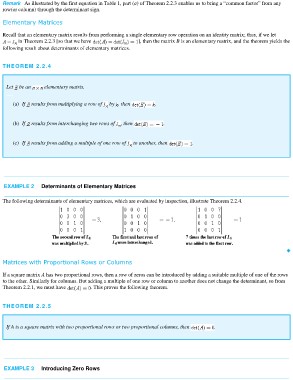
Remark As illustrated by the first equation in Table 1, part (a) of Theorem 2.2.3 enables us to bring a “common factor” from any
row(or column) through the determinant sign.

Elementary Matrices

Recall that an elementary matrix results from performing a single elementary row operation on an identity matrix; thus, if we let

in Theorem 2.2.3 [so that we have                            ], then the matrix B is an elementary matrix, and the theorem yields the

following result about determinants of elementary matrices.

THEOREM 2.2.4

Let be an elementary matrix.                                 .
   (a) If results from multiplying a row of by , then

(b) If results from interchanging two rows of , then            .

(c) If results from adding a multiple of one row of to another, then                  .

EXAMPLE 2 Determinants of Elementary Matrices
The following determinants of elementary matrices, which are evaluated by inspection, illustrate Theorem 2.2.4.

Matrices with Proportional Rows or Columns

If a square matrix A has two proportional rows, then a row of zeros can be introduced by adding a suitable multiple of one of the rows

to the other. Similarly for columns. But adding a multiple of one row or column to another does not change the determinant, so from

Theorem 2.2.1, we must have  . This proves the following theorem.

THEOREM 2.2.5

If A is a square matrix with two proportional rows or two proportional columns, then     .

EXAMPLE 3 Introducing Zero Rows

