


Page 157 - Elementary_Linear_Algebra_with_Applications_Anton__9_edition
P. 157
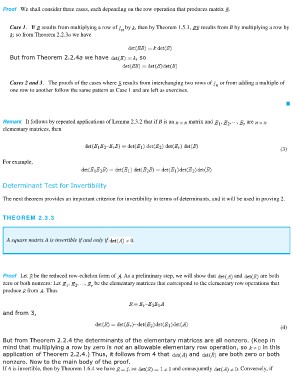
Proof We shall consider three cases, each depending on the row operation that produces matrix .

   Case 1. If results from multiplying a row of by , then by Theorem 1.5.1, results from B by multiplying a row by
     ; so from Theorem 2.2.3a we have

But from Theorem 2.2.4a we have                    , so

Cases 2 and 3. The proofs of the cases where results from interchanging two rows of or from adding a multiple of
one row to another follow the same pattern as Case 1 and are left as exercises.

Remark It follows by repeated applications of Lemma 2.3.2 that if B is an  matrix and , , , are
elementary matrices, then

                                                                                                                  (3)

For example,

Determinant Test for Invertibility

The next theorem provides an important criterion for invertibility in terms of determinants, and it will be used in proving 2.

THEOREM 2.3.3

A square matrix A is invertible if and only if  .

Proof Let be the reduced row-echelon form of . As a preliminary step, we will show that and are both
zero or both nonzero: Let , , , be the elementary matrices that correspond to the elementary row operations that
produce from . Thus

and from 3,

                                                                                                                  (4)

But from Theorem 2.2.4 the determinants of the elementary matrices are all nonzero. (Keep in

mind that multiplying a row by zero is not an allowable elementary row operation, so             in this

application of Theorem 2.2.4.) Thus, it follows from 4 that and are both zero or both

nonzero. Now to the main body of the proof.

If A is invertible, then by Theorem 1.6.4 we have , so   and consequently  . Conversely, if

