


Page 231 - Elementary_Linear_Algebra_with_Applications_Anton__9_edition
P. 231
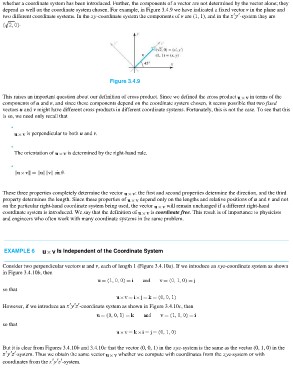
whether a coordinate system has been introduced. Further, the components of a vector are not determined by the vector alone; they
depend as well on the coordinate system chosen. For example, in Figure 3.4.9 we have indicated a fixed vector v in the plane and
two different coordinate systems. In the -coordinate system the components of v are (1, 1), and in the -system they are

         .

                                                           Figure 3.4.9

This raises an important question about our definition of cross product. Since we defined the cross product in terms of the
components of u and v, and since these components depend on the coordinate system chosen, it seems possible that two fixed
vectors u and v might have different cross products in different coordinate systems. Fortunately, this is not the case. To see that this
is so, we need only recall that

             is perpendicular to both u and v.

      The orientation of is determined by the right-hand rule.

                                 .

These three properties completely determine the vector : the first and second properties determine the direction, and the third
property determines the length. Since these properties of depend only on the lengths and relative positions of u and v and not
on the particular right-hand coordinate system being used, the vector will remain unchanged if a different right-hand
coordinate system is introduced. We say that the definition of is coordinate free. This result is of importance to physicists
and engineers who often work with many coordinate systems in the same problem.

EXAMPLE 6  Is Independent of the Coordinate System

Consider two perpendicular vectors u and v, each of length 1 (Figure 3.4.10a). If we introduce an -coordinate system as shown
in Figure 3.4.10b, then

so that

However, if we introduce an -coordinate system as shown in Figure 3.4.10c, then

so that

But it is clear from Figures 3.4.10b and 3.4.10c that the vector (0, 0, 1) in the -system is the same as the vector (0, 1, 0) in the
       -system. Thus we obtain the same vector whether we compute with coordinates from the -system or with

coordinates from the -system.

