


Page 276 - Elementary_Linear_Algebra_with_Applications_Anton__9_edition
P. 276
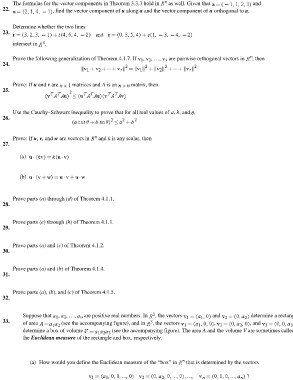
The formulas for the vector components in Theorem 3.3.3 hold in as well. Given that          and

22. , find the vector component of u along a and the vector component of u orthogonal to a.

     Determine whether the two lines
23.

     intersect in .

     Prove the following generalization of Theorem 4.1.7. If , , …, are pairwise orthogonal vectors in , then
24.

     Prove: If u and v are  matrices and A is an      matrix, then
25.

     Use the Cauchy–Schwarz inequality to prove that for all real values of a, b, and ,
26.

     Prove: If u, v, and w are vectors in and k is any scalar, then
27.

         (a)

         (b)

     Prove parts (a) through (d) of Theorem 4.1.1.
28.

     Prove parts (e) through (h) of Theorem 4.1.1.
29.

     Prove parts (a) and (c) of Theorem 4.1.2.
30.

     Prove parts (a) and (b) of Theorem 4.1.4.
31.

     Prove parts (a), (b), and (c) of Theorem 4.1.5.
32.

Suppose that , , …, are positive real numbers. In , the vectors and determine a rectang

33. of area                 (see the accompanying figure), and in , the vectors          ,   , and

determine a box of volume                       (see the accompanying figure). The area A and the volume V are sometimes called

the Euclidean measure of the rectangle and box, respectively.

(a) How would you define the Euclidean measure of the “box” in that is determined by the vectors

