


Page 287 - Elementary_Linear_Algebra_with_Applications_Anton__9_edition
P. 287
For example, the image of the vector

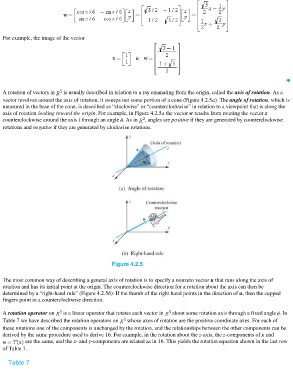
A rotation of vectors in is usually described in relation to a ray emanating from the origin, called the axis of rotation. As a
vector revolves around the axis of rotation, it sweeps out some portion of a cone (Figure 4.2.5a). The angle of rotation, which is
measured in the base of the cone, is described as “clockwise” or “counterclockwise” in relation to a viewpoint that is along the
axis of rotation looking toward the origin. For example, in Figure 4.2.5a the vector w results from rotating the vector x
counterclockwise around the axis l through an angle . As in , angles are positive if they are generated by counterclockwise
rotations and negative if they are generated by clockwise rotations.

                                                           Figure 4.2.5
The most common way of describing a general axis of rotation is to specify a nonzero vector u that runs along the axis of
rotation and has its initial point at the origin. The counterclockwise direction for a rotation about the axis can then be
determined by a “right-hand rule” (Figure 4.2.5b): If the thumb of the right hand points in the direction of u, then the cupped
fingers point in a counterclockwise direction.
A rotation operator on is a linear operator that rotates each vector in about some rotation axis through a fixed angle . In
Table 7 we have described the rotation operators on whose axes of rotation are the positive coordinate axes. For each of
these rotations one of the components is unchanged by the rotation, and the relationships between the other components can be
derived by the same procedure used to derive 16. For example, in the rotation about the z-axis, the z-components of x and

            are the same, and the x- and y-components are related as in 16. This yields the rotation equation shown in the last row
of Table 7.

  Table 7

