


Page 306 - Elementary_Linear_Algebra_with_Applications_Anton__9_edition
P. 306
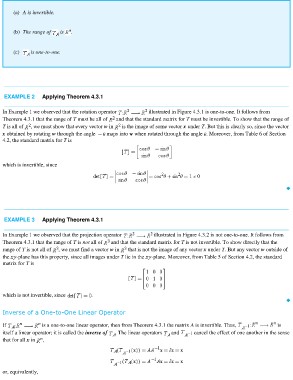
(a) A is invertible.
(b) The range of is .
(c) is one-to-one.

EXAMPLE 2 Applying Theorem 4.3.1

In Example 1 we observed that the rotation operator    illustrated in Figure 4.3.1 is one-to-one. It follows from

Theorem 4.3.1 that the range of T must be all of and that the standard matrix for T must be invertible. To show that the range of

T is all of , we must show that every vector w in is the image of some vector x under T. But this is clearly so, since the vector

x obtained by rotating w through the angle maps into w when rotated through the angle . Moreover, from Table 6 of Section

4.2, the standard matrix for T is

which is invertible, since

EXAMPLE 3 Applying Theorem 4.3.1

In Example 1 we observed that the projection operator  illustrated in Figure 4.3.2 is not one-to-one. It follows from

Theorem 4.3.1 that the range of T is not all of and that the standard matrix for T is not invertible. To show directly that the

range of T is not all of , we must find a vector w in that is not the image of any vector x under T. But any vector w outside of

the -plane has this property, since all images under T lie in the -plane. Moreover, from Table 5 of Section 4.2, the standard

matrix for T is

which is not invertible, since     .

Inverse of a One-to-One Linear Operator

If is a one-to-one linear operator, then from Theorem 4.3.1 the matrix A is invertible. Thus,                                    is

itself a linear operator; it is called the inverse of . The linear operators and  cancel the effect of one another in the sense

that for all x in ,

or, equivalently,

