


Page 342 - Elementary_Linear_Algebra_with_Applications_Anton__9_edition
P. 342
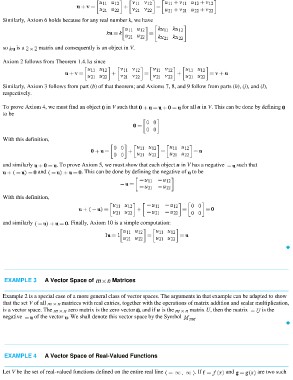
Similarly, Axiom 6 holds because for any real number k, we have

so is a matrix and consequently is an object in V.
Axiom 2 follows from Theorem 1.4.1a since

Similarly, Axiom 3 follows from part (b) of that theorem; and Axioms 7, 8, and 9 follow from parts (h), (j), and (l),
respectively.

To prove Axiom 4, we must find an object in V such that                    for all u in V. This can be done by defining
to be

With this definition,

and similarly           . To prove Axiom 5, we must show that each object u in V has a negative  such that

               and . This can be done by defining the negative of to be

With this definition,

and similarly           . Finally, Axiom 10 is a simple computation:

EXAMPLE 3 A Vector Space of  Matrices

Example 2 is a special case of a more general class of vector spaces. The arguments in that example can be adapted to show

that the set V of all   matrices with real entries, together with the operations of matrix addition and scalar multiplication,

is a vector space. The  zero matrix is the zero vector , and if u is the   matrix U, then the matrix is the

negative of the vector . We shall denote this vector space by the Symbol .

EXAMPLE 4 A Vector Space of Real-Valued Functions                          . If and are two such
Let V be the set of real-valued functions defined on the entire real line

