


Page 340 - Elementary_Linear_Algebra_with_Applications_Anton__9_edition
P. 340
5.1                 In this section we shall extend the concept of a vector by extracting the
                    most important properties of familiar vectors and turning them into axioms.
REAL VECTOR SPACES  Thus, when a set of objects satisfies these axioms, they will automatically
                    have the most important properties of familiar vectors, thereby making it
                    reasonable to regard these objects as new kinds of vectors.

Vector Space Axioms

The following definition consists of ten axioms. As you read each axiom, keep in mind that you have already seen each of
them as parts of various definitions and theorems in the preceding two chapters (for instance, see Theorem 4.1.1).
Remember, too, that you do not prove axioms; they are simply the “rules of the game.”

    DEFINITION

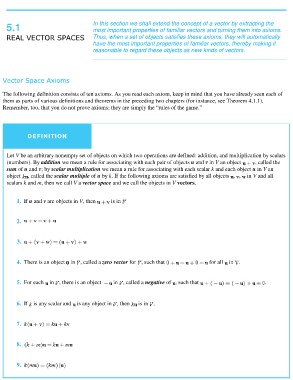
Let V be an arbitrary nonempty set of objects on which two operations are defined: addition, and multiplication by scalars
(numbers). By addition we mean a rule for associating with each pair of objects u and v in V an object , called the
sum of u and v; by scalar multiplication we mean a rule for associating with each scalar k and each object u in V an
object , called the scalar multiple of u by k. If the following axioms are satisfied by all objects , , in V and all
scalars k and m, then we call V a vector space and we call the objects in V vectors.

1. If u and v are objects in V, then  is in

2.

3.

4. There is an object in , called a zero vector for , such that            for all in .

5. For each in , there is an object in , called a negative of , such that                .

6. If is any scalar and is any object in , then is in .

7.

8.

9.

