


Page 349 - Elementary_Linear_Algebra_with_Applications_Anton__9_edition
P. 349
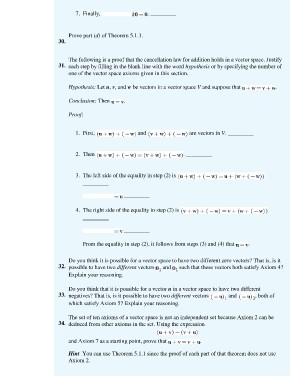
7. Finally,                            . _________

     Prove part (d) of Theorem 5.1.1.
30.

     The following is a proof that the cancellation law for addition holds in a vector space. Justify
31. each step by filling in the blank line with the word hypothesis or by specifying the number of

     one of the vector space axioms given in this section.

Hypothesis: Let u, v, and w be vectors in a vector space V and suppose that                    .

Conclusion: Then .

Proof:

1. First, and are vectors in V. _________

2. Then                                             . _________

3. The left side of the equality in step (2) is                              .
   _________
                         _________

4. The right side of the equality in step (2) is
   _________
                         _________

   From the equality in step (2), it follows from steps (3) and (4) that

     Do you think it is possible for a vector space to have two different zero vectors? That is, is it
32. possible to have two different vectors and such that these vectors both satisfy Axiom 4?

     Explain your reasoning.

Do you think that it is possible for a vector u in a vector space to have two different

33. negatives? That is, is it possible to have two different vectors  and , both of

which satisfy Axiom 5? Explain your reasoning.

     The set of ten axioms of a vector space is not an independent set because Axiom 2 can be
34. deduced from other axioms in the set. Using the expression

and Axiom 7 as a starting point, prove that         .

Hint You can use Theorem 5.1.1 since the proof of each part of that theorem does not use
Axiom 2.

